Supporting people living with dementia and frailty requires caregivers to understand not only their care needs, but also how communication, dignity, and caregiver wellbeing can influence everyday care.
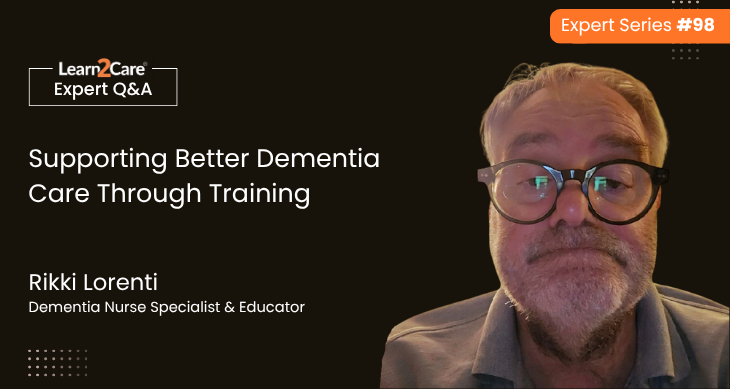
Rikki Lorenti, RMN, ENM, an Independent Dementia Nurse Specialist & Educator with over 40 years of nursing experience, shares her insights on dementia care training, communication, mental wellbeing, and putting learning into practice.
Keep reading to discover her insights.
It is World Alzheimer’s Month, and the theme is “getting a timely diagnosis”. Worldwide (even in first-world countries), no one is achieving that. Some continents have made great advances that have increased diagnosis rates, but most still fall short in providing the same level of access in rural areas. Certain populations worldwide also find access difficult because of cultural norms.
Closer to home, as someone who has facilitated training, I have seen the inconsistent approach to providing training at all levels, and the expectation that care leaders can lead and support the wellbeing of their teams, and ultimately those that they care for, with no additional training. Get it right, and families and those being cared for have a fighting chance of getting the quality care they deserve. Relying on online training with no follow-up to see whether what was learned has affected practice makes it a tick-box exercise with no sustainability.
Training is imperative, but it needs to focus on the practicalities of how dementia and frailty impact both the individual requiring care and the informal support network around them. Training needs to have an element of follow-up, an opportunity for those attending to reflect on whether the care of the individual has improved. In other words, no one should leave an online or face-to-face session without the option to be coached in applying the knowledge in practice, recognizing the need for sustainability.
– Rikki Lorenti, RMN, ENM | Independent Dementia Nurse Specialist & Educator
Is it about empathy? Understanding how the person is feeling and how you project your frustration onto the person being cared for allows you to “reboot” and start again. Understand your own well-being, acknowledge stress as early as possible, and take a step back to understand yourself. Avoid negative interaction (they call it malignant social psychology); don’t treat the individual as someone who has no capacity to make decisions or try a task for themselves. Try to see the person and focus on what they can do, not what they can’t.
Think about yourself once in a while. It is like a set of scales; if there is no balance between you and the person being cared for, at some point “care will break down”. Don’t say “I haven’t got the time”, because at some point you will have the time when care breaks down, and others take over. If you want to be the carer in control, don’t lock everyone out; if you are offered support, then take it.
Rikki’s insights highlight the importance of looking beyond training completion and focusing on how learning translates into everyday care.

Rikki Lorenti, RMN, ENM, is an Independent Dementia Nurse Specialist & Educator with over 40 years of nursing experience. She specializes in dementia, frailty, older people's mental health, and palliative care.
Rikki collaborates with partners to deliver expert training and facilitation services, drawing on her extensive clinical background to develop tailored courses addressing critical healthcare challenges. Her work focuses on empowering healthcare professionals with the knowledge and skills needed to enhance patient care.
With expertise spanning healthcare, healthcare management, and coaching, Rikki is committed to advancing best practices in dementia and related fields while building a sustainable freelance training business.
Discover further wisdom from industry experts by exploring our curated collection of knowledge.