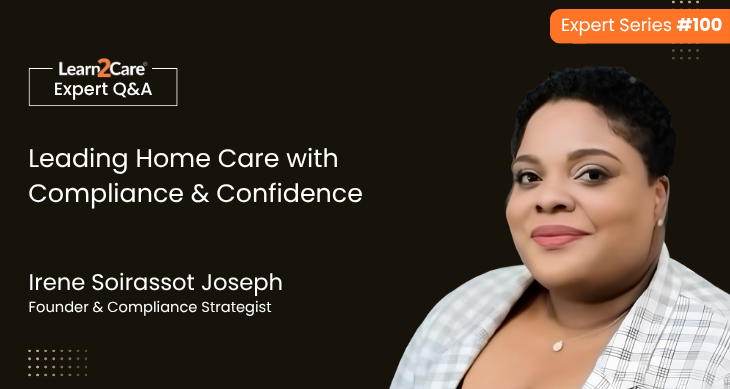
Running a home care organization involves more than just knowing the regulations or handling the day-to-day operations; leaders have to strike a balance between the quality of care, supporting their staff, maintaining accountability, and ensuring compliance, all while setting up systems that can support the organization in the long term.
Irene Soirassot-Joseph, who holds a master’s degree in nursing (MSN) and is a registered nurse (RN), is a Compliance Strategist, a former Joint Commission Surveyor, and the founder of ILS CARE Regulatory Solutions; she has gained experience at every stage of the care process, ranging from providing bedside nursing and management through to taking on roles in compliance leadership and conducting regulatory surveys. The way she sees it, effective leadership, practical systems, and a supportive culture can combine to improve both the quality of care and organizational performance.
Irene talks about the experiences that influenced her method of leadership, the lessons she has picked up over time, and offers some practical advice to home care leaders who want to develop stronger teams and make compliance an everyday part of their work.
Keep reading to discover her insights.
The way I lead can be traced back to my experience covering the entire range of care—beginning my career as a hospice LPN, then moving on to become a registered nurse, working as a field nurse, progressing to a management position, serving as a compliance specialist, and finally acting as a Joint Commission surveyor. By observing care delivery from both the bedside and from the regulatory perspective, I learned how leadership decisions have a direct impact on patient outcomes, staff confidence, and the integrity of the organization.
The hardest thing to come to terms with has been the fact that good intentions on their own are not sufficient. Although many leaders are very concerned, organizations that lack systems, accountability, and clarity still have difficulty even when they are well-meaning. To deal with this I changed my approach from trying to fix problems to instead creating sustainable structures—such as education, clear expectations, and decisions based on data.
I should have realized earlier that leadership is not so much about having all the answers as it is about setting up an environment in which your team can think critically, speak up, and develop. Good leaders don’t carry the entire burden—they develop teams that can.
– Irene Soirassot-Joseph, MSN, RN | Founder, ILS CARE Regulatory Solutions
In order to run a successful home care agency you need three things: clinical credibility, operational discipline and emotional intelligence. You have to know about the regulations, respect the real situation of the frontline staff, and remain firm about the reason why the work is important. Only when these elements are aligned will quality and sustainability result.
Compliance shouldn’t be seen as a burden; instead it should be part of the organization’s culture. The way to achieve this is to make compliance practical, steady, and linked to patient care rather than viewing it as a simple checklist. Leaders must give continuous education, promote open communication, and supply their staff with the necessary tools and confidence so that they can do the right thing each day.
Once team members understand the reasons for the policies and don’t feel judged but rather supported, compliance turns into a joint responsibility that enhances both the quality of care and the organization’s success.
As Irene pointed out, effective leadership in the field of home care goes beyond simply having good intentions; it demands clear systems, supportive leadership, practical compliance procedures, and a culture in which team members feel ready to contribute to the quality of care.

Irene Soirassot-Joseph, MSN, RN, is a Compliance Strategist, former Joint Commission Surveyor, and Founder of ILS CARE Regulatory Solutions. Her experience spans hospice nursing, home health, quality assurance, compliance leadership, and regulatory surveying.
rene, who has expertise in QAPI, CMS regulations, staff education, and survey readiness, assists home care and hospice agencies in improving their compliance, enhancing documentation, and in establishing sustainable systems that support quality care; her efforts are directed at helping healthcare leaders prepare their teams, strengthen the organization's processes, and treat compliance as an ongoing element of providing high-quality care.
Discover further wisdom from industry experts by exploring our curated collection of knowledge.