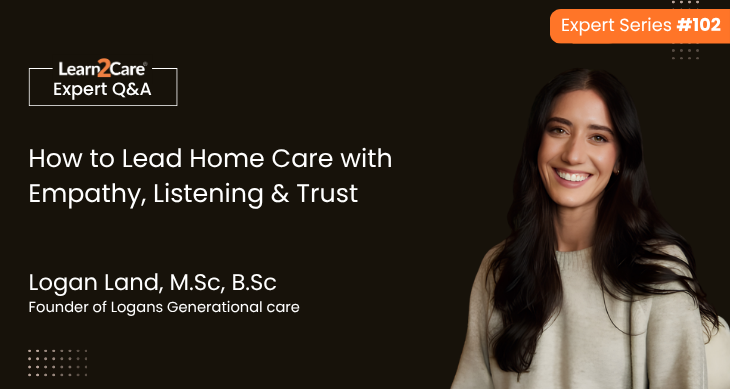
Logan Land’s journey towards leadership in the field of home care started when she looked after her grandmother following her diagnosis of dementia. The experience gave her a clear insight into the needs of families and formed the basis of Logans Generational Care Corporation.
Logan, who is a caregiver, advocate, and speaker, has real-life experience to draw on when discussing person-centered care and the people who deliver it. In this interview, she talks about the way that caregiving has shaped her leadership, the importance of listening, and what she would say to someone who is leading a home care agency for the first time.
Keep reading to discover her insights.
The fact that I became a caregiver for my grandmother following her diagnosis has had a profound effect on the way I lead. I didn’t enter the field of home care via a conventional business or clinical route instead, my involvement was based on love, a sense of grief, and a feeling of responsibility. The act of sitting by someone you care about as they lose parts of themselves teaches you patience, humility, and how important it is to be present rather than perfect. This experience forms the basis of Logan’s Generational Care and the way I lead: people come first, always.
The most difficult thing I’ve learned is that care can’t be sped up or made uniform, even though systems would have us think it can. At first, there was a sense that I should “do it the right way” as dictated by policies, deadlines, and productivity measures. However, dementia care showed me that each individual and each family has their own particular needs. To come to this realization, I relied on lived experience, listened carefully to both caregivers and families, and introduced flexibility into our care model, even though this makes things more difficult from an operational point of view.
It is not necessary to become emotionally hardened in order to be an effective leader. In the past I believed that leadership involved being emotionally detached or always having the correct answers. However, I have since realized that vulnerability, empathy, and honesty actually contribute to stronger teams and better care. Taking a human approach to leadership is not a weakness—it is a skill.
– Logan Land, M.Sc., B.Sc. | Founder, Logans Generational Care Corporation
You really have to care—not merely about growth but about people in general, such as clients, families, and caregivers. Success in the field of home care is achieved by listening, making adjustments, and being prepared to feel uncomfortable whenever things are difficult. It will be obvious if you’re involved in this work for the sake of quick results or relying on strict formulas; but if you base your approach on respect, flexibility, and genuine concern, then the impact and success will result.
Learn by first listening. Take the time to understand the experiences of your clients, their families, and the frontline caregivers before attempting to alter systems or procedures. It is the people who are giving and receiving care who will teach you more than any handbook ever could. Keep your curiosity, stay humble, and always remember the human individual behind each of your decisions. Whenever compassion directs your leadership, trust will follow—and trust forms the basis of outstanding care.
The way Logan has looked after her grandmother has led to a leadership style based on empathy, active listening, and flexibility.

Logan Land, who holds degrees of M.Sc. and B.Sc., is the founder of Logans Generational Care Corporation and serves as a dementia caregiver, advocate, and speaker with the aim of changing the way families experience dementia care. Motivated by her own experience of looking after her grandmother, Logan brings together her personal experiences with compassionate leadership in order to promote person-centered care, support for caregivers, and connections across generations. Having previously played hockey at the NCAA Division I level, she is committed to helping families and care organizations act with empathy, flexibility, and humanity while enhancing the quality of life for people who have dementia.
Discover further wisdom from industry experts by exploring our curated collection of knowledge.