At Learn2Care, we value the voices of caregivers who navigate the complexities of supporting loved ones while balancing careers, families, and everyday responsibilities.
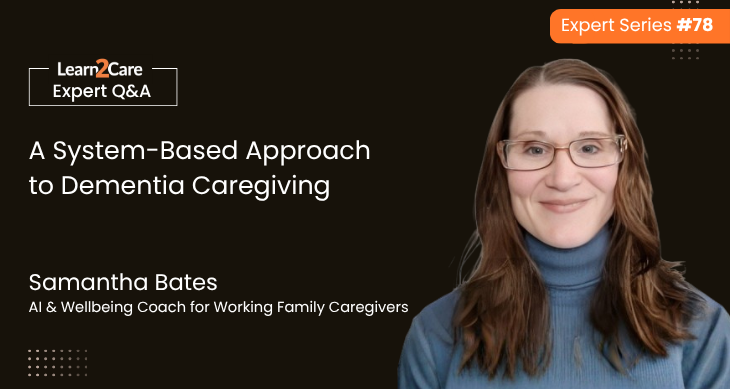
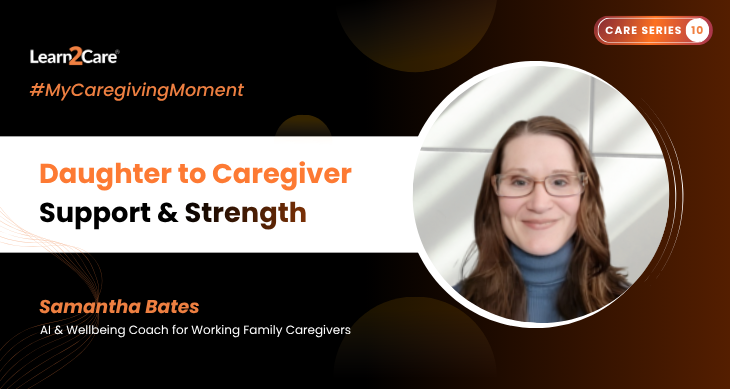
We spoke with Samantha Bates, a caregiver, coach, and advocate who helps working professionals caring for parents with dementia. Drawing from her own caregiving experience, Samantha helps others build sustainable systems that reduce stress and create greater confidence during challenging times.
Here is Samantha’s story, in her own words.
My caregiving journey began in childhood, when I would occasionally care for a sick sibling while my parents worked. I still remember sitting with my sister in our shared bedroom, telling her funny stories to ease her anxiety and help her fall asleep.
Even then, I sensed that caring for others would always be part of my life.
Over the years, that role evolved—first into motherhood, and now into caring for my elderly parents, who have lived in my home for the past six years.
Living in a three-generation household has shown me that caregiving is not one fixed role. It unfolds in many phases and at many levels, each with its own demands, lessons, and rewards.
Building Systems for Care
My daily caregiving routine has shifted over time, depending on how many people I’m caring for and their needs.
Most days begin early, checking in on my daughter and my mom and making sure their needs are met throughout the day and into the evening.
My responsibilities include preparing meals, managing household tasks, coordinating doctor appointments, supporting physical therapy, and following through on care plans.
Caregiving requires both big-picture thinking and consistent daily execution. It is a continuous balance of planning ahead, anticipating needs, and responding to what happens in the moment.
One of the biggest challenges I faced was realizing that caregiving often lacks the systems and structures we rely on in other areas of life.
In corporate and academic environments, there are established processes designed to support success. In caregiving, I found that many of those supports did not exist automatically.
I had to intentionally build those systems myself—creating routines, finding resources, and developing structures that would support both my loved ones and my own well-being.
What helped me most was gaining the right knowledge, tools, and support network. With those in place, even complex challenges became more manageable, and solutions began to take shape.
The Promise That Changed Everything
Shortly after my dad passed away in 2025, I experienced a realization that has stayed with me ever since.
He was able to pass peacefully at home, in part because I reassured him that I would always be there to care for and watch over my mom.
In that moment, I felt the full weight and honor of that promise—the mantle of care shifting from my dad to me.
It was a profound reminder that caregiving is not only about tasks. It is also about trust, love, and carrying forward a commitment to the people we cherish.
My message to new caregivers is simple: create the same level of support for yourself that you create for your loved one.
Seeking help is not a weakness—it is a sign of strength.
Caregiving is not meant to be carried alone. Stay connected with someone who understands the journey, whether that is a fellow caregiver or a support group. Having someone who can walk alongside you makes all the difference.
Samantha Bates works with corporate people whose parents have dementia. Her Dementia Care Leadership Framework enables them to minimize the crisis stress, preserve their careers, and establish sustainable care systems. Having balanced her own full-time career and the work of taking care of her parents when their memory failed, medical decisions, and emotions, she had made the roadmap that she wanted. Her practice is a combination of her personal experience, corporate leadership training, coaching, and practical means, such as AI-enhanced systems, to make high-performing professionals feel clear, manage crises, communicate effectively in the workplace, and decrease the emotional load.
Discover further wisdom from industry experts by exploring our curated collection of knowledge.