Dementia changes more than memory. It can affect communication, relationships, daily routines, and the way families connect with someone they love. For caregivers, understanding these changes can make the difference between simply getting through a difficult moment and creating a meaningful connection.
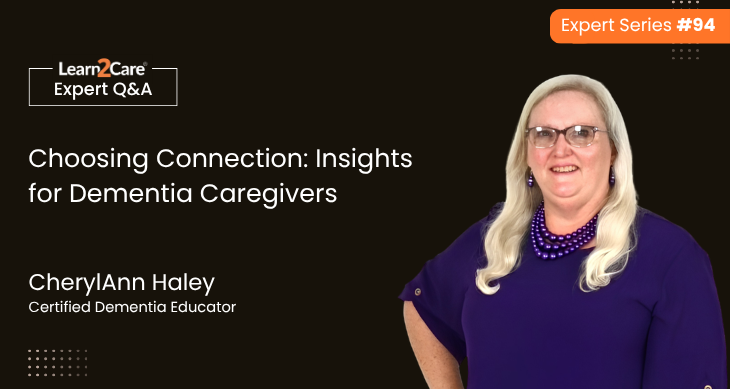
CherylAnn Haley brings both professional knowledge and deeply personal experience to dementia care. As a Positive Approach to Care Certified Dementia Educator and the founder of Sandy’s Daughter Dementia Education and Support, she helps families better understand dementia and adapt the way they communicate, connect, and provide support. Her perspective is also shaped by 10 years of supporting her own mother through dementia.
In this conversation, CherylAnn shares what she wishes every family understood about dementia, how changes in the brain affect communication, why caregivers sometimes need to adapt their own approach, and what it means to choose the relationship over the activity.
Keep reading to discover her insights.
Dementia is hard, and no family is fully prepared for it when it joins them. Even the families who have already had a loved one with dementia may face new challenges because “if you have met one person with dementia, you have met one person with dementia.” Families do not have the luxury of putting off decisions until a better time. Dementia does not wait for a family to be mentally ready to make plans and decisions.
Understanding how dementia changes a person’s five senses, especially sight and hearing, is a key piece of communication between a caregiver and someone with dementia. These senses also change as the brain changes. Using the structured sensory cueing steps of Teepa Snow’s Positive Approach to Care in the early states of dementia is a game changer that allows caregivers to adapt as their loved one changes. Approaching from the front and stopping before entering personal space allows the person with dementia to make eye contact and focus in on the person approaching.
This takes away any element of surprise at the initial interaction. Speaking the person’s name in a friendly conversational way while also sharing the caregiver’s name begins a friendly interaction. Friendly conversation helps eliminate distress or anxiety concerning who is approaching. Lastly, extending a hand for a handshake gives the person with dementia the opportunity to reach out and be the person who makes the contact. While there are additional parts of Positive Physical Approach to adapt to many variables, starting with this basic concept helps prevent distress for both people.
An important piece to keep in mind is that dementia is a physical condition. The brain is failing. Just as we would not expect someone to carry a heavy bag with a broken arm or run a race with a broken leg, we need to remember a person will lose capacity to complete some tasks that they have done with ease in the past. On the other hand, we cannot limit their abilities at the very beginning of a diagnosis. As cliché as it may be, we must realize the person is not giving us a hard time, but they are having a hard time. Dementia affects a person’s executive functioning.
Managing large projects or completing tasks with multiple steps often becomes a problem. Partnering with the person to complete these larger projects helps strengthen the connection as a caregiver supports and does not take over. This may require the caregiver to use patience and change their own way of doing something.
– CherylAnn Haley, Positive Approach to Care Certified Dementia Educator
Many people shut off someone affected by dementia, believing that they no longer know them or do not have the ability to interact. Dementia is a difficult journey for the entire family. Maintaining contact and relationships with someone with dementia is a benefit for both the person with dementia and their friend or family member. During the entire dementia journey, the person inside does not leave.
If a person without dementia learns how brain changes affect a person and how to interact by understanding the changes, they will be able to maintain the relationship. Activities may need to be adapted, but time together will be valuable for both. Do not give up on someone with dementia. Learn to understand dementia and how YOU need to change.
You can do this. It may take a deep look into a mirror to see how you might need to change yourself to make it through, but you will not regret it. Do not fall into the victim mentality that society paints of being a caregiver. It is hard but possible. Dementia will change you. Let it change you for the better. After 10 years of supporting my Mom with dementia before her recent death, I can look in the mirror and see how I have changed. I am kinder.
I am more considerate. I value life – my own as well as others – more. While I wish my Mom and I never had to go through this, I count this opportunity to now help others as one of the greatest opportunities I could have. When people look at me and the life I lived with my Mom with dementia, I hope I inspire them to not be victims but be fighters for themselves and their loved ones.
As CherylAnn shared, dementia caregiving is not only about adapting to changes in another person. It can also mean changing how caregivers communicate, respond, and connect throughout the journey.

CherylAnn Haley is a Positive Approach to Care Certified Dementia Educator and the founder of Sandy’s Daughter Dementia Education and Support in Tampa, Florida. Drawing from dementia education and 10 years of personal experience supporting her mother through dementia, CherylAnn helps families better understand brain change, communication, and ways to maintain meaningful relationships throughout the dementia journey. Before focusing on dementia education and advocacy, she spent more than nine years with Chapters Health Foundation, where her experience included nonprofit and volunteer management.
Discover further wisdom from industry experts by exploring our curated collection of knowledge.