Summary
Home care compliance is now scrutinized more closely and with a data-driven approach as regulators and payers cross-check caregivers’ qualifications and training records against EVV data service authorizations visit notes incident reports and claims so even a minor discrepancy can trigger a more extensive investigation. For agencies training records are a vital control since missing compliance training delayed orientation expired credentials incomplete assessments or undocumented remedial education make it hard to show workers were properly prepared and while audit frequency varies by state payer and agency type agencies must be able to produce clear evidence at any time.
Home care compliance is about more than completing required training; it depends on strong training program fundamentals. Agencies must stay current with changing regulations. They must also assign the right training for each role and location.
Tracking completion is equally important. So is maintaining accurate records and providing evidence when regulators or auditors request it.
Missing records, misplaced certificates, and overdue training can create serious problems. Even small gaps can result in audit findings. They generally lead to corrective actions, delayed renewals, operational disruption, and added pressure on your team.
This guide will help you identify compliance gaps early. You will learn how to strengthen training records, prepare your staff, and keep documentation audit-ready throughout 2026.
Home care compliance means adhering to the laws, licensing standards, payer requirements, contracts, and the agency’s internal policies that apply to its services and workforce. The specific duties will vary according to the state, the agency license, the caregiver role, the services provided, the funding source, and the nature of the payer relationship.
A non-medical agency that works on a private-pay basis could have different duties from a personal care provider who receives funding from Medicaid or from a home health agency that is certified under Medicare. Furthermore, agencies operating in several states might also need different training programs for the same caregiver positions.
| Area | Evidence an agency may need |
| Training | Orientation, annual hours, required topics, assessments, competency checks, and certificates |
| Caregiver qualifications | Background checks, health screenings, work eligibility, and role-specific credentials |
| Client services | Assessments, service agreements, care plans, authorizations, and required updates |
| Visit documentation | Timely notes showing which authorized services were provided |
| EVV | Required visit data and documented resolution of exceptions |
| Client protection | Rights, privacy, complaint procedures, incident reporting, and follow-up |
| Policies | Current procedures that match applicable requirements and actual practice |
| Claims | Records supporting services submitted for payment |
Home care compliance training is one part of this wider responsibility. Agencies must provide the right education and retain evidence through clear caregiver training documentation.
A compliance audit is a review of an agency’s records, practices, and internal controls against specific legal, regulatory, contractual, or organizational requirements. Depending on the agency and the services it provides, a review may be conducted by a state regulator, Medicaid agency, managed care organization, payer, accrediting body, independent reviewer, or the agency’s internal team. Not every external review is formally called an “audit”; it may instead be described as a survey, inspection, monitoring review, compliance review, or documentation review, depending on the reviewing entity and purpose.
The review process may be routine or risk-based, or it may be triggered by a complaint, critical incident, unusual billing pattern, repeated EVV exceptions, a previous deficiency, or discrepancies between records—such as when EVV data, visit documentation, service authorizations, and billing records do not align.
| Review type | Primary purpose | Common reason |
| Audit | Tests records and practices against defined criteria | Routine monitoring, payer review, or identified risk |
| Regulatory survey | Evaluates licensing or certification requirements | Initial license, renewal, periodic review, or complaint |
| Investigation | Examines a specific allegation, incident, or suspected violation | Complaint, referral, adverse event, or discrepancy |
| Internal review | Finds gaps before an outside reviewer does | Scheduled monitoring, quality improvement, or corrective action |
Usually, reviewers assess the evidence rather than the intentions; just because a caregiver has been trained or a policy has been followed does not make up for the lack of supporting records.
There is not a single national database that records each and every audit of every home care agency in the United States; oversight is shared among federal agencies, the state regulators, the Medicaid programs, the managed care organizations, the accrediting bodies, and other payers. It would thus be misleading to say that each type of agency is being audited more frequently in every state.
Just because these activities take place doesn’t mean that every agency will have to undergo an immediate review; they do indicate that oversight bodies can check whether the services were carried out as authorized, had been provided by qualified staff, and were backed by consistent records.
Home care agencies operate in an environment where compliance information is increasingly interconnected. Rather than looking at one document in isolation, reviewers may compare training, staffing, EVV, authorization, billing, incident, and personnel records to determine whether requirements were met consistently.
This means a record that appears complete on its own can still raise questions when compared with other agency data. Here are five areas that can increase compliance scrutiny.
A training record might seem to be complete by itself, but a gap could be noticed when it is compared with the hire dates, the work assignments, the incidents, the client’s needs, and the credential records.
For example, if a caregiver starts working on their own on June 1 but the date for their required orientation is listed as June 8, a reviewer could ask who was in charge of the caregiver during that period and whether the assignment had been approved.
EVV introduces an extra level of oversight by allowing visit times and locations to be compared with schedules, authorizations, visit notes, payroll records, and claims. The fact that there are discrepancies does not necessarily mean that there has been wrongdoing, but consistent or unexplained exceptions could result in further investigation.
Home- and community-based services are offered at thousands of different locations, and supervision mainly depends on documentation showing that the approved services have taken place, that the clients have been protected, and that the workers have met the relevant requirements.
Caregivers’ qualifications, their records of course completion, their EVV records, their service authorizations, any incidents, and any corrective actions may all come under closer review by agencies that take part in Medicaid or that are part of contracted payer networks.
A complaint about a missed visit, privacy concern, unsafe practice, or reporting failure may lead a reviewer to ask:
A single incident can be isolated, while a number of incidents concerning the same subject may point to a more general flaw in training or supervision.
L2C Compliance Check
A caregiver incident occurs. Can you quickly prove what training was required, when it was completed, whether competency was verified, and what follow-up occurred?
Audit readiness starts with evidence—not assumptions.
The rules relating to home care are not the same all over the country; the required hours, the topics to be covered, the methods of delivery, the assessments, the competency checks, and the length of time for which records must be kept can differ from state to state and also depend on the payer, the caregiver’s role, the type of service, and the agency’s license.
A course plan approved for one post or site might not be suitable for another. Risk can be avoided only if agencies do not assign a single standard curriculum without first checking which requirements apply to each worker.
The more frequent the departures of staff members, the larger the number of people who join and then leave the organization. Each time there is a change in the staff, the new employee has to go through orientation, be given course assignments, undergo screenings, have their qualifications verified, be entered in the personnel records, and be granted access to client information.
Failure to follow consistent procedures can result in orientation records being missing, annual education being submitted late, files being incomplete, or the evidence demonstrating that a caregiver had received the necessary preparation before beginning work being unclear. Even if better caregiver retention helped to reduce some of the administrative workload, the agencies would still need reliable controls regardless of how the workforce changed.
Digital training logs allow an agency to demonstrate that it has explained to people the responsibilities of caregivers, the rights of clients, the duties connected with reporting, the safety procedures, the requirements concerning professional boundaries, and the expectations regarding documentation. They also show the agency’s approach in dealing with a situation in which an incident or a concern about performance revealed a lack of knowledge.
Where applicable, a record should identify:
A certificate may not answer every question. A reviewer may also need to know whether the course was completed before the deadline, matched the caregiver’s role, and satisfied the correct requirement.
Agencies may face questions when records show:
The fact that there are gaps doesn’t necessarily indicate that the caregiver was unprepared; it does, however, make it more difficult for the agency to show that the requirements had been met.
OIG’s General Compliance Program Guidance identifies training and education, risk assessment, auditing and monitoring, and corrective action among the seven elements of a compliance program. The guidance is voluntary and nonbinding, but it offers a useful framework for organizations participating in healthcare programs.
Create, customize, and scale effective caregiver training – from onboarding to specialized care.
There are many reasons that can cause an external review like:
| Potential trigger | What may raise concern | Preventive action |
| Missing training evidence | Hours, topics, assessments, or certificates cannot be verified | Review records routinely and correct gaps transparently |
| Late course completion | Orientation or annual education missed its deadline | Monitor due dates and intervene before work continues |
| Expired credentials | Required checks, screenings, licenses, or certificates are no longer current | Track renewal dates and begin follow-up early |
| EVV exceptions | Repeated manual entries, overlaps, or unexplained corrections | Investigate exceptions promptly and document valid reasons |
| Record mismatches | Claims, schedules, notes, authorizations, and EVV do not align | Reconcile supporting records before submission |
| Complaints or incidents | Concerns involve safety, rights, privacy, missed care, or conduct | Investigate, report, correct, and document follow-up |
| Repeat findings | The same issue returns after a corrective action | Verify that each correction remains effective |
At first, reviewers might look at only a few files; if the same issue occurs more than once, they could broaden the scope to include other caregivers, other locations, or other time periods.
| Risk area | Possible effect |
| Financial | Claim denial, payment recovery, delayed reimbursement, or corrective-action costs |
| Regulatory | Plan of correction, follow-up review, added monitoring, or licensing action |
| Operational | Staff time spent locating records, retraining workers, revising policies, and responding to requests |
| Client safety | Caregivers may be unclear about duties, escalation, or required practices |
| Reputation | Reduced confidence among clients, families, caregivers, payers, and referral partners |
Not every finding produces a serious penalty. The response depends on the requirement, severity, pattern, client impact, agency history, and speed and quality of correction.
Prepare a list of the requirements, grouping them by state, by caregiver role, by service, by agency license, and by funding source, and in that list indicate the orientation deadlines, the annual hours, the required topics, the assessments, the competency expectations, the credentials, and the record-keeping periods.
It would be wrong to assume that a single course plan will be appropriate for all workers; instead, you should check what the requirements are before giving them education.
Select new employees, long-term employees, different types of caregivers, those working at multiple locations, caregivers who work with clients covered by Medicaid, and caregivers who have taken part in recent incidents.
For each file, confirm that:
Record the gap, the pertinent requirement, the individual responsible, and the deadline for making the correction.
Pay attention to issues involving a worker who appears to be unqualified, to education that was finished after work had already begun, to expired qualifications, to gaps relating to incidents which have not been resolved, and to records that do not support the services that were provided.
Corrective actions can involve giving a student a course that they were missing, repeating an assessment, carrying out a competency check, updating a file, revising a policy, putting an assignment on hold until the necessary requirements have been fulfilled, or offering supervisor coaching.
Ensure that the corrections are not backdated or concealed; you must keep a record of the changes made, the reasons for those changes, the person who approved them, and when the correction occurred.
Ask someone who does not manage the records every day to test whether the agency can quickly answer:
Set up a continuous review schedule according to the findings, and a mock review is seen as a success only if it picks up on weaknesses at an early stage rather than if it assigns a perfect score.
Help caregivers understand legal duties, protect client rights, document correctly, and report concerns confidently.
Use a simple review rhythm:
| Frequency | Recommended action |
| Weekly | Check new hires, overdue courses, expiring credentials, and unresolved assignments |
| Monthly | Review completion by role, location, and due date |
| Quarterly | Audit a sample of caregiver files against current requirements |
| After an incident | Determine whether training, competency, or supervision contributed |
| After a rule change | Review affected courses, policies, assignments, and records |
| Annually | Reassess the full training plan and complete a formal risk review |
Once you have filled in the gap, you must check the results to ensure that the caregiver has carried out the prescribed education, passed the assessment, demonstrated the required competency, and has followed the modified procedure in practice.
Audit readiness looks different for non-medical home care and Medicare-certified home health organizations. The requirements an agency needs to monitor depend on its license, services provided, payer relationships, caregiver roles, and applicable federal and state requirements.
| Parameter | Non-medical home care | Medicare-certified home health |
| Services | Personal care, companionship, homemaking, ADL support | Skilled nursing, therapy, home health aide services |
| Requirements | Primarily state, payer, and applicable Medicaid requirements | State requirements plus applicable Medicare/CMS requirements |
| Training | Varies by state, role, service, and payer | Federal aide standards may apply alongside state requirements |
| Records | Training, qualifications, EVV, and service records | Training, competency, personnel, and service records |
| Audit focus | Evidence meets applicable state and payer requirements | Evidence meets applicable state and Medicare requirements |
Home care agencies that are not engaged in medical services should not suppose that all the requirements set out by CMS apply to them. Those agencies which have been certified by Medicare have to determine the extra federal standards associated with their certification and with the services they provide. CMS states that its Conditions of Participation are the minimum health and safety standards which apply to agencies seeking reimbursement from Medicare.
Federal home health aide qualification, classroom and supervised practical training, competency, and in-service requirements are addressed in 42 CFR 484.80. (42 CFR 484.80 – Home Health Aide Services)
Just having course certificates on file is not enough to achieve audit readiness. Agencies might be required to demonstrate what training was assigned, who carried out the training, when it was completed, and whether the caregiver had met the requirements of the course.
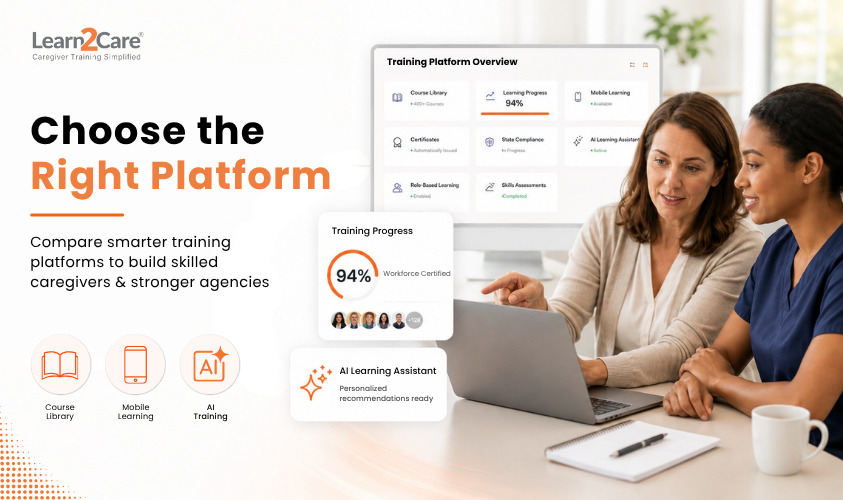
Learn2Care has combined all this information on a single training platform, so that agency leaders can keep an eye on progress, spot any training that has not been completed, and get access to the training records without having to go through spreadsheets, emails, or paper files.
With Learn2Care, agencies can:
Set up structured learning programmes for orientation, annual training, continuing education, and for the various caregiver roles.
You can view your course assignments, completion status, the training hours you have completed, your certificates, any tasks that are overdue, and your assessment results all from a single dashboard.
Make sure that incomplete or overdue training is addressed before it leads to gaps in documentation or has an impact on audit readiness.
Keep your training records, reports, and certificates in a single location so that they can be easily retrieved when inspections, audits, or internal reviews take place.
Wherever there is an incident, a complaint, a performance concern, or an internal review which shows a knowledge gap, refresher or remedial education should be assigned.
Provide a consistent level of education to all teams and locations at the same time, customising the learning routes to meet the requirements of different roles and types of training.
Learn2Care provides more than 300+ online caregiver and leadership courses, including those that are specific to individual states and relevant to the role. The topics covered are client rights, prevention of abuse, infection control, care for people with dementia, emergency preparedness, fall prevention, documentation, privacy, professional boundaries, and caregiver safety.
Are you ready to simplify caregiver training and recordkeeping?
Explore Learn2Care for Agency Owners and Managers
For home care agencies, completing required caregiver training is only half of the compliance responsibility. Agencies also need clear evidence of what training was assigned, when it was completed, how it was assessed, and what follow-up occurred when gaps were identified.
To be ready for audits year-round involves keeping an eye on training deadlines, checking the records to see if there is any missing or inconsistent information, quickly dealing with any gaps, and recording the steps taken to correct them. By carrying out these practices all throughout the year, home care agencies will find it easier to respond when their training records are asked for during an audit, a review, or an inspection.
Can your agency quickly prove what training was assigned, completed, and assessed?
Learn2Care helps home care agencies build and maintain audit-ready training records by centralizing caregiver training, completion data, assessments, and supporting evidence.
The specific requirements will differ depending on the state, the services offered, the kind of license, the payer, the role of the caregiver, and the funding source; they may include such areas as the qualifications of the caregiver, orientation, annual education, the rights of the client, documentation, EVV, incident reporting, care plans, privacy, and claims support. Agencies must check the requirements with the relevant regulator, the payer, the contract, or a qualified advisor.
Regulators and payers are able to compare caregiver files, course histories, schedules, EVV records, care plans, incidents, and claims. Using such comparisons, it is possible to identify late training, missing evidence, unresolved exceptions, or discrepancies between the services that have been authorized and those that have been documented.
They can ask for orientation records, their annual course histories, titles and topics, the dates on which they were completed, the training hours, the assessments, the certificates, evidence of their competency, and proof the training met state-compliant certification requirements information about any remedial education, and proof that the courses satisfied the applicable requirements.
Yes, if a law, licensing standard, payer contract, agency policy, or corrective-action plan demands it, then missing, late, incomplete, or inappropriate education may result in a finding. The risk goes up if the caregiver had worked before the requirement was completed, the clients were affected, or the same gap is found in several files.
You should identify the relevant requirements, look at a representative sample of the caregiver and client files, check the training and qualification deadlines, verify the assessments and certificates, reconcile the service records, clearly deal with any gaps, and carry out a mock review. Readiness must be kept up throughout the year and not only begun when a notice is received.
Find your next read and expand your knowledge
Contact us to inquire about our state-wise training courses and take the first step towards upskilling your team with a 14-day free trial!