 caregiver-onboarding-checklist
Quick Summary
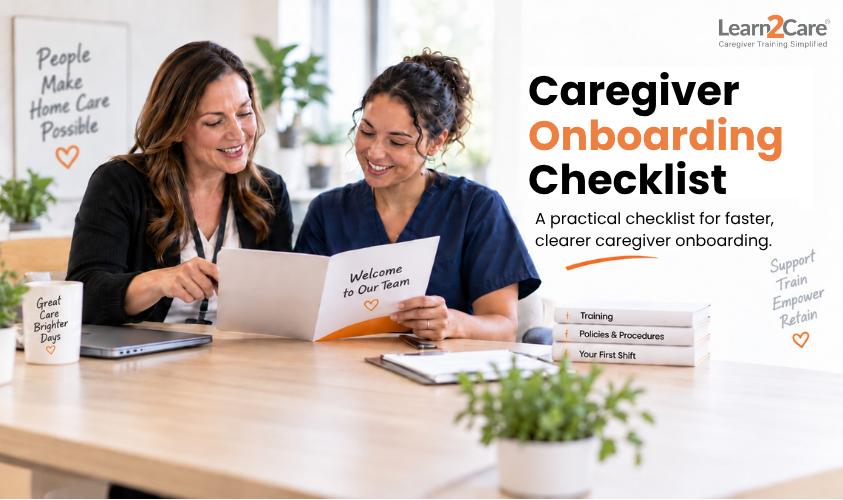
A strong caregiver onboarding process gives every applicant a clear path from application to first shift. It combines prompt communication, honest role expectations, required documents, relevant training, human support, and a final readiness check.
The guide includes a practical onboarding workflow for home care, together with a step-by-step checklist, suggestions regarding training, opportunities for automation, criteria for measuring success, and the various ways in which Learn2Care can assist with the training aspect of onboarding.
Hiring a caregiver is not the end of the process; it marks the start of a transition that moves the candidate from interested to ready for their first assignment.
If the transition involves mainly forms, long intervals of silence, and instructions given at the last minute, new employees might feel confused or disengaged. Having a structured onboarding process for caregivers removes the uncertainty by providing timely communication, appropriate training, human support, and clear milestones.
The aim goes beyond just getting people through the process more quickly; it is to eliminate any unnecessary confusion and, at the same time, help each caregiver reach their first shift feeling informed, prepared, and connected to the appropriate support.
The process used to get a caregiver ready to work safely, confidently, and consistently is known as caregiver onboarding. It can involve the hiring procedures, the necessary documentation, orientation, training, introductions to supervisors or mentors, preparation for their first assignment, verification of competency, and support with early performance.
Preboarding includes the period that lies between the moment an application is made, or an offer is accepted and the caregiver’s first day. Although onboarding can go on after the caregiver has started working, this guide concentrates on the part of the process that involves a lot of friction, namely the journey from application to the first shift.
For home care agencies, onboarding should accomplish four goals:
The specific requirements depend on the state, the payer, the type of service, and the role of the caregiver. In addition, home health agencies that are certified by Medicare must comply with the relevant federal requirements, such as those concerning the qualifications and competency of home health aides set out in 42 CFR § 484.80. Instead of applying a single checklist as a general standard for compliance, agencies should check to make sure they are following the rules that apply to their own staff.
For the full walkthrough, see our caregiver onboarding guide.
A few onboarding difficulties arise in the period between the moment when someone is hired and when they are given their first assignment. At that time, the new caregiver might be waiting for their background check to be completed, filling in forms, comparing their offer with others, or attempting to work out if the job suits their availability and experience.
Common sources of friction include:
The answer isn’t just to send more messages; effective onboarding makes sure that the correct information is delivered at the right moment and assigns a clear owner to each step.
Early exits also drive turnover; see why caregivers quit in their first months.
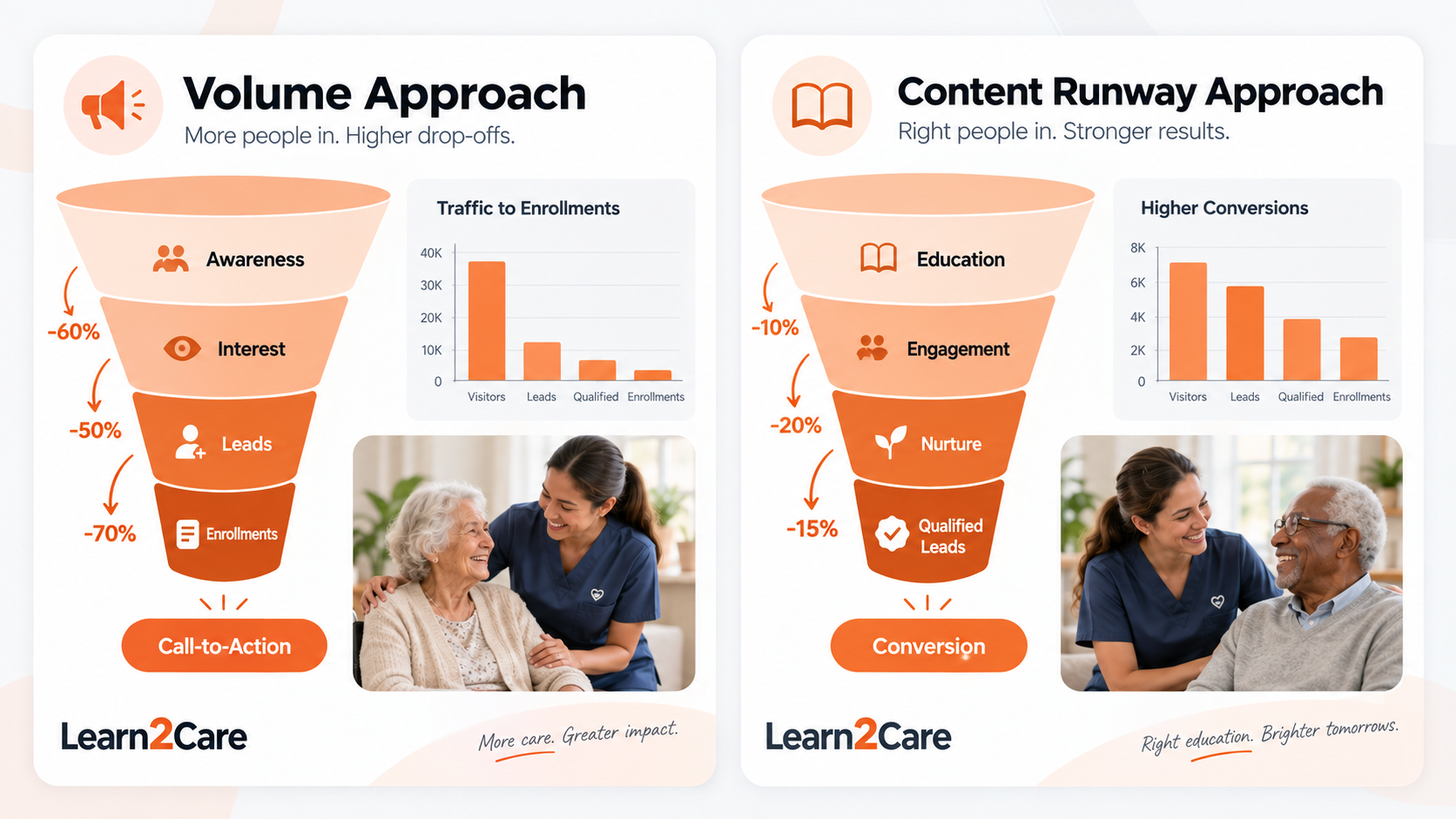
The Onboarding Content Runway consists of a series of brief and helpful touchpoints that take a caregiver from the point at which they apply through to being ready for their first shift. Rather than viewing onboarding as an event involving only paperwork, it combines communication, training, and a personal connection.
The initial message should serve to confirm that the application or offer has been received and then outline the subsequent steps.
Send:
A short welcome video from the scheduler, trainer, or agency leader can give the process a more personal touch. It doesn’t have to involve complicated production; what’s needed is a clear message and an identifiable point of contact.
Expectation content enables a new caregiver to understand the job before going through orientation or taking on an assignment.
Provide:
Make the materials as brief and practical as possible so that a caregiver can relate each one to a situation they might come across in the client’s home.
Before carrying out the first task, focus on giving personal support and making sure you are ready.
Include:
You should not use standard email or text messages when passing on protected or sensitive client information unless the agency has first confirmed that the method is both authorized and secure.
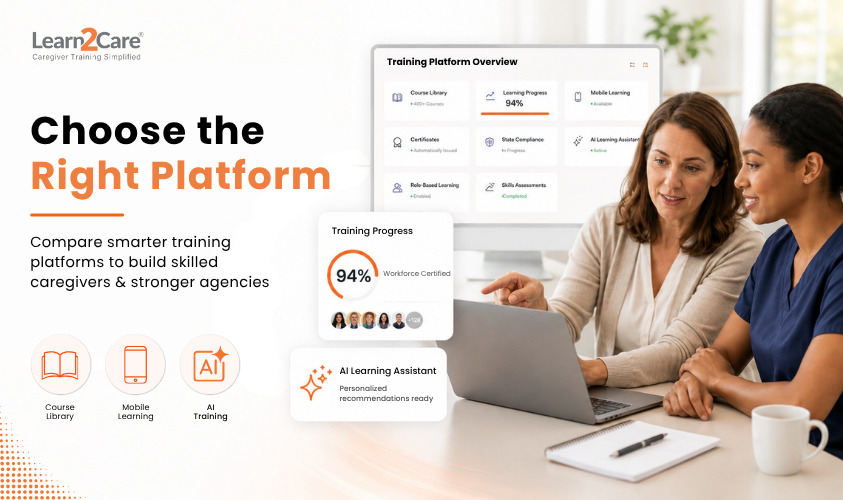
Learn2Care supports the training portion of this journey. Agencies can assign role-appropriate courses, add their own policies and procedures, monitor progress, and confirm training completion before a caregiver’s first shift.
It helps administrators get a clearer view of each caregiver’s progress. While giving new hires a simple, mobile-friendly place to complete their learning. The platform supports the process without replacing the human conversations, supervision, or hands-on competency checks.
Take the checklist as a starting point and modify it considering the agency’s policies, the relevant laws, the payers’ requirements, and the caregiver roles.
| Onboarding Stage | Agency Actions | Expected Outcome |
| Application received | Confirm receipt; explain the next steps; provide one contact | Knows what will happen and whom to contact |
| Screening and offer | Clarify duties, pay rate, schedule, travel expectations, and contingencies | Can make an informed decision |
| Pre-start preparation | Collect required documents; assign relevant introductory learning; send reminders | Completes requirements without unnecessary repetition |
| Day 1 orientation | Review mission, policies, reporting, privacy, safety, and workplace expectations | Understands the agency and essential responsibilities |
| Orientation and training | Complete role-appropriate learning; introduce the supervisor or mentor; answer questions | Connects training to expected work |
| Assignment preparation | Confirm authorized duties, schedule, secure client information, reporting contacts, and support arrangements | Understands the assignment without receiving unnecessary information |
| First-shift readiness check | Confirm required steps are complete; review arrival instructions, escalation procedures, and questions | Starts the first shift with clear expectations and support |
Looking for more ways to strengthen your workforce?
Explore Learn2Care’s Caregiver Recruitment, Onboarding & Retention Courses
The training ought to correspond to the caregiver’s role, previous experience, the tasks assigned to them, the needs of the client, and the relevant requirements. It is important not to provide new employees with the same detailed list without explaining what is required, what is specific to their role, and what might be done at a later stage.
A home care onboarding curriculum commonly addresses:
The fact that someone has completed training does not mean that they are competent in all tasks; agencies must still provide practical instruction, observation, supervision, delegation, and carry out competency verification when this is required.
The best practices for onboarding new caregivers in home care and elderly care settings are practical rather than complicated:
The same rules apply to home health onboarding, but home health agencies that are certified by Medicare and the various clinical positions may be subject to extra requirements from federal, state, payer, and supervision sources.
Caregiver onboarding automation is most effective when it comes to handling routine administrative tasks and can help avoid missed handoffs without turning the experience into one consisting of impersonal messages from the system.
Good uses of automation include:
Do not use automation for sensitive talks about performance, decisions about skills, replies to safety concerns, or talks that need judgment and empathy.
Learn2Care can support this part of onboarding by helping agencies assign role-based training, track progress, organize completion records and certificates, and follow up on outstanding learning.
Learn2Care’s AI-powered tools provide additional support throughout this process:
Used thoughtfully, automation and AI can make onboarding more organized, accessible, and responsive. They should support, not replace. The supervisors, trainers, and agency leaders who provide clarification, coaching, hands-on instruction, competency verification, and personal support.
Virtual support for onboarding caregivers can make it easier to access training and communication, particularly in the case where caregivers work at a number of different locations. The most effective virtual approach involves:
Virtual onboarding shouldn’t be used to take the place of human supervision. Even if a caregiver has understood a concept online, they will still need demonstration, observation, or some form of corrective coaching before carrying out the task by themselves.
Monitor a small number of indicators throughout the entire workflow and, over time, compare the results to see where caregivers are waiting, withdrawing, or asking for additional support.
| Metric | What It Measures |
| Application-to-interview rate | Early candidate engagement |
| Offer acceptance rate | Clarity and competitiveness of the offer |
| Offer-to-orientation completion | Effectiveness of preboarding communication |
| Orientation-to-first-shift rate | Readiness and process friction |
| Time to first shift | Speed of hiring and deployment |
| Required training completion | Progress toward learning requirements |
| Pre-shift training completion | Progress toward required learning |
| First-shift readiness exceptions | Missing steps or support needs before deployment |
You must not judge the program just by how fast it is, since a more concise procedure is not better if it omits essential checks or assigns a caregiver before the agency has confirmed that they are ready.
New caregivers should always know what training they need, what they have completed, and what comes next. Agency administrators also deserve a better way to manage onboarding than using spreadsheets, scattered certificates, and constant follow-up messages.
Learn2Care helps home care agencies organize caregiver training during onboarding. The platform combines caregiver courses, agency content, progress tracking, and completion records in one place.
With Learn2Care, agencies are able to:
Learn2Care offers more than 400 online courses and over 300 hours of training across foundational caregiving, specialized care, compliance, onboarding, retention, and leadership topics.
Learn2Care supports the training component of onboarding. Each agency remains responsible for its hiring process, background checks, orientation, hands-on instruction, supervision, competency verification, delegation, and assignment decisions.
Give every caregiver a clearer path to their first shift.
Explore the Learn2Care AI-powered online caregiver training platform.
See how your agency can assign role-based training. Add agency-specific content, track progress, and keep caregiver development moving beyond onboarding.
The benefits of improving the onboarding process for caregivers go beyond just getting a new employee through the paperwork, since it sets up a clear and well-supported path from the time they apply until they are assigned their first job.
A highly effective approach involves maintaining timely communication, setting out clear expectations, providing appropriate training, using automation for routine tasks, and ensuring continuous human support. If every stage has a definite purpose and is assigned to a specific person, then home care agencies will be able to detect any difficulties earlier and prepare caregivers more consistently for their first shift.
Onboarding should feel clear for caregivers and manageable for the people supporting them.
Learn2Care helps home care agencies build a more consistent training journey with role-based learning, agency-specific content, progress tracking, certificates, and AI-supported tools.
Book a Learn2Care demo and see how your agency can create a smoother path from application to first shift.
Prepare a prompt response, explain each step, clarify the duties and the scheduling, assign training that is appropriate for the role, appoint a supervisor or mentor, verify understanding and competence where this is necessary, and perform a readiness check before the first shift.
There is no single onboarding process that applies to all caregivers since the time interval between applying and actually starting work depends on the role, the requirements of the state, the kind of service, the background checks, the training, the competency evaluation, and the agency’s own policies. Agencies must give caregivers a realistic schedule and keep them informed if a required step causes a delay.
Preboarding takes place before the caregiver begins work and is concerned with communication, documentation, expectations, and preparation. Onboarding then goes on after the start date and includes orientation, training, supervised practice, feedback, and early development.
A large number of communication, documentation, and learning activities can be carried out virtually; yet certain agencies might still need face-to-face identification, demonstration of skills, observation, verification of competency, or supervision depending on the role and the relevant requirements.
Learn2Care enables agencies to organize the training element of onboarding by means of mobile learning, role-specific pathways, real-world scenarios, progress tracking, the awarding of certificates, and specialized content. It acts as a supplement—not a replacement—to the agency’s hiring, orientation, supervision, and competency processes.
Find your next read and expand your knowledge
Contact us to inquire about our state-wise training courses and take the first step towards upskilling your team with a 14-day free trial!