Summary
A home care referral program involves more than just establishing relationships. Agencies also need to ensure their caregivers can support clients with more complex needs. Agencies can improve their readiness to pursue higher-acuity care by combining reliable referral partnerships with structured professional caregiver training that prepares teams for more complex client needs. By focusing on appropriate referral sources and understanding what those sources expect, agencies can build stronger partnerships. Likewise, when an agency has a well-prepared workforce, its referral partners are more confident in its ability to meet a range of care needs.
Every home care agency wants more referrals. Fewer agencies ask what referral partners need to see before they send one.
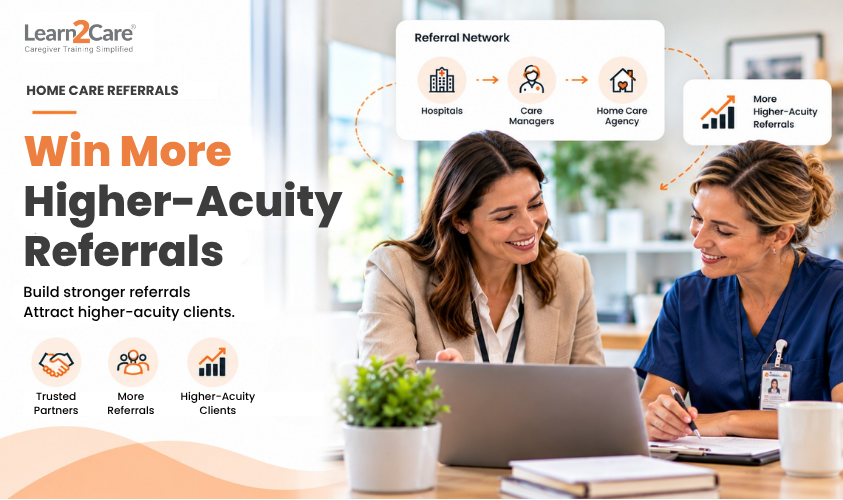
A discharge planner with a patient going home tomorrow isn’t looking for the friendliest agency. They want one that can follow a care plan, notice changes, and pick up the phone when something is off. A hospice team wants caregivers who understand their role. A family dealing with dementia wants to know your caregivers have been trained for it.
That’s the gap between getting referrals and getting higher-acuity referrals. Clients with post-hospital needs, dementia, end-of-life care, or a high fall risk. A strong home care referral program gets you in the door. Proof of preparation earns the second referral.
In this blog, you’ll find 16 referral sources for your home care referral program. For each one, you’ll see what the partner needs from you and which clients they’re best suited to send. You’ll also get practical tips for building a referral program and a look at how caregiver training helps you back up what you promise.
Higher-acuity referrals involve prospective clients whose health, cognitive, mobility, behavioral, safety, or support needs require greater caregiver preparation, coordination, or specialized knowledge than routine personal care cases.
| Care Need | Key Support | Caregiver Readiness |
| Post-Hospital Discharge | Mobility, ADLs, safety, observation | Follow the care plan and report concerns |
| Advanced Dementia | Personal care, communication, behavior, safety | Dementia-specific skills and supervision |
| Hospice Care | Comfort, dignity, personal and emotional support | Understand role and coordinate with hospice |
| Other Complex Conditions | Condition-specific support and observation | Work within state rules, agency services, and scope |
Complex care needs create new growth opportunities.
Hospitals should have safe arrangements in place for patients exiting inpatient care. To provide support beyond their skilled services, home health agencies may need personal care partners. Similarly, hospice teams will also require reliable caregivers, and hospice training for caregivers helps them understand the importance of comfort, dignity, and the changes that take place at the end of life.
Families may also want an agency with experience in a particular condition.
Preparing for these needs can help an agency expand the range of clients it can safely support.
It can also make referral conversations more specific.
Instead of saying: We give great home care.
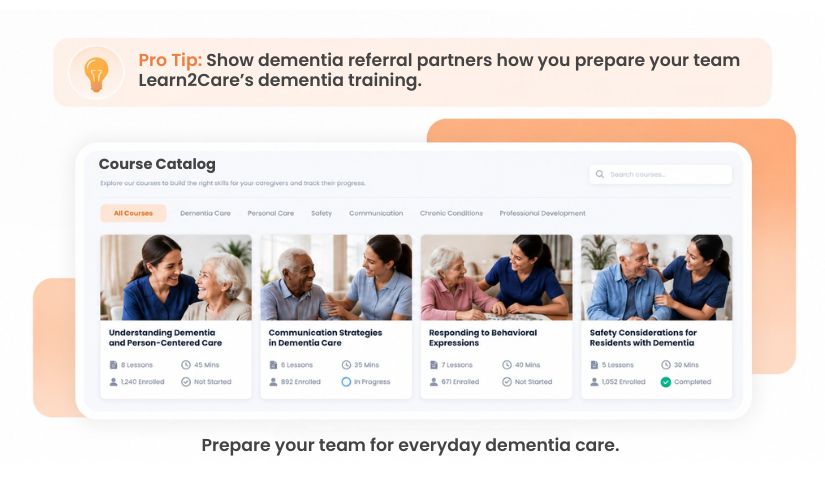
You can explain: Caregivers who care for people with dementia receive special training in communication, behavior, the risks associated with wandering, safety, and daily care.
This gives referral partners information about the agency’s readiness.
Tell us which clients you want more of, like post-discharge, dementia, or hospice, and we’ll show you the training that helps you earn those referrals.
If you want to set yourself apart from the others and get more referrals, you should establish relationships with the local hospital discharge planners.
Facility discharge planners must ensure their patients do not return to the hospital within 30 days, or they can be fined.
They maintain a list of the different types of after-hospital care available in their area, for example, home health care, home care, and housing for the elderly, and function basically as gatekeepers by advising patients and their families on where to proceed.
They’ll look at you first if you’ve got a good record of the quality of care you’ve received, you’ve given your telephone number to the discharge planners in your area, and you have a relationship with them.
Contact satisfied (past and present) clients and ask whether they know anyone else who might benefit from the services you offer.
Ask social workers to keep your home care agency on file as a referral option when skilled care agencies are not suitable.
Advertise your home care services by contacting local doctors and pharmacists.
Go to the doctor’s office and show them how your home care agency can supplement or add to the government-funded programs.
Palliative care is a branch of medicine that is becoming more popular and is intended to improve quality of life, achieve better patient outcomes, and lower costs.
Only half of the palliative care programs in the country have links with hospice companies, which implies that the other 50% is still available.
Palliative care training programs are provided in doctors’ offices, through health networks, and in other private agencies like Learn2Care.
Take the time to enter into a special agreement with local financial and estate planning professionals who can refer clients; such arrangements are generally ten to twenty times more profitable than a typical hospital referral.
On the one hand, these clients may need many hours of care from a caregiver each day for years and be able to afford it; on the other hand, because you have exclusivity, you aren’t competing with other home care agencies.
Offer to be a guest speaker at independent living facilities, such as assisted living or nursing and rehab facilities, so you can meet residents who may require additional personal and supportive care services not currently offered.
It’s worth establishing connections with the main long-term care insurance companies, but, as with financial service arrangements, the policies won’t be mutually exclusive.
Your home care agencies in that area will generally be registered with the insurance companies, and you need to ensure your agency receives more direct referrals.
Make sure you offer the highest-quality caregiver services, so insurance companies don’t learn about any complaints.
Second, keep a record of referrals from insurance representatives and prepare a list of their names and contact details for future marketing campaigns. By staying in touch, you’ll keep your home care agency top of mind.
Residential care homes constitute an alternative to conventional assisted living facilities that look after elderly or disabled people. Although they offer standard caregiver services, they do not provide medical care or treatment; in such a case, your home care agency can take over.
Look for residential care homes in your local area, develop a working relationship with them, and set up a referral system.
Home care agencies usually receive referrals from one of two types of caregiver funding available to America’s veterans.
The Aid and Attendance benefit is available to veterans who served actively during certain wars or “periods of conflict,” and eligibility is determined by financial need, age, and physical condition.
Usually, third-party organizations that help veterans obtain the benefit enter into direct contracts with care provider companies; they refer clients to their preferred home care agency partners, and the Veterans Administration finances the services.
The other caregiver funding scheme is known as the “Homemaker Program,” and it is carried out and managed by the regional VA Hospitals. Although programs differ by location, caregiver service hours are limited. Eligibility is more flexible, and the VA Hospital functions as the direct payer.
Non-competing medical services can set up strategic partnerships that benefit both parties. For example, fall detection devices complement home care services.
The home care agency can offer the fall detection device to their clients as a value-add. Likewise, the technology provider can reciprocate by selling home care services to their clients.
This is a fun, beneficial way to find clients: sponsor and take part in local events for seniors, such as races and festivals, and make sure your name appears on advertising leaflets and banners. This helps the local community become aware of your home care agency.
A non-medical home care agency might work with skilled home health agencies to provide personal care and other support services.
Join local, state, and national organizations and obtain accreditations to show your agency’s commitment to quality care; then publicize your achievements in the local media to build your reputation in the community.
Geriatric care managers, sometimes called aging life care professionals, are usually nurses or social workers. They assess older adults, build care plans, and coordinate services for families. This is often because the family lives far away or is overwhelmed. They choose providers on the family’s behalf. They rely on agencies they can trust to follow the plan they create.
Local Alzheimer’s Association chapters, dementia support groups, memory cafés, adult day programs. And memory care communities are often the first place families turn after a diagnosis. Their staff hears daily from caregivers who are struggling and need help at home. They can only recommend an agency they believe understands dementia.
Once you decide which sources to target, it’s time to establish your home care referral program.
In this situation, the goal is to make it as easy as possible for your referral partners to promote YOUR services to THEIR clients.
Take the time to gather several resources into one referral packet to make a good impression and set yourself apart from your competitors.
For instance, you could include the following in your referral packet:
| Referral Packet Item | What to Include |
| Company Story | Your company story |
| Services Sheet | Services Sheet |
| Third-Party Satisfaction Reports | Third-party Satisfaction Reports |
| Client and Caregiver Testimonials | Client and caregiver testimonials |
| Service Area Map | Service Area Map |
| Awards | Awards you’ve earned |
| Onboarding Process Sheet | Onboarding Process Sheet |
| Team Bios | Team Bios |
You might also include a one-liner to hand over to your clients; the core of your USP should either explain why you are the best choice or outline how your programs or services differ from those of other agencies.
Your packet can also explain how new caregivers move from hiring to assignment readiness. A structured caregiver onboarding checklist can help agencies document the steps from application and required training through first-shift preparation.
A relationship that benefits both sides should lead to advantageous results for both parties, which in turn encourages more partnerships. The following guidelines should be followed:
For instance, you might form a partnership with a technology company and sell their products—like a fall detection device—to your clients in return for them selling you their services.
Although home care agencies receive referrals from hospitals or doctors’ offices, they often don’t know the doctors, caseworkers, or social workers who make them.
But they could get even more referrals by getting to know their sources personally.
Instead of just knowing the hospital’s name, doctor’s office, or medical center, you could get to know the person who is making the referral. By nurturing personal relationships, you’ll receive more referrals in the future and show the person you’re a trustworthy resource.
A relatively low-cost, simple way to stay top of mind with clients and offer an extra incentive to refer others is to send referral cards.
Send the people in question a referral card every three to four months, and the card should offer them a discount on a service when they refer friends to your agency.
Social media is becoming increasingly popular, and its user base now exceeds half of the world’s population.
Because all generations are influenced by the facts and opinions available on social media, home care agencies should build a presence on various social channels and connect with social workers, physicians, and patients.
Over time, home health consumers will be influenced more by social media.
As with any marketing strategy, you should keep a record of your performance. Check your referrals from time to time, then review them monthly and quarterly. Without tracking, it’s almost impossible to assess the effectiveness of your referral sources.
Once you know which sources provide the highest number of quality referrals, you can invest more time and resources in the channels that are producing the right opportunities. Referral activity should be reviewed alongside broader home care performance metrics such as client growth, caregiver capacity, retention, and revenue.
You not only get the chance to expand your network, take part in seminars, and stay up to date with the latest industry news by joining appropriate associations, but also have the opportunity to speak at their events to display your expertise and build your credibility. You can also stay in touch with the people you meet and build stronger business relationships.
A referral partner is trusting you with someone vulnerable. When they ask, “how do you prepare your caregivers for this?”, a specific answer gives them a reason to refer again.
Learn2Care gives agencies a way to build that answer into everyday operations:
| When a referral partner asks… | How Learn2Care helps you respond |
| “Are your caregivers trained for dementia?” | Dementia training pathways covering communication, behavior, safety and daily care |
| “Can you support a client coming home from the hospital?” | Training on mobility, fall prevention, observation, and reporting concerns |
| “Do your caregivers understand hospice?” | Hospice and palliative care courses on comfort, dignity, and coordinating with the care team |
| “Can you show me proof of training?” | Course-completion records and tracking, so documentation is easy to share |
| “Does this meet our state’s requirements?” | State-specific training options aligned with applicable requirements |
| “Can you take on more complex clients over time?” | 400+ courses and role-based paths to expand caregiver skills as your services grow |
Need a downloadable state-by-state reference? Browse our state caregiver training eBooks for practical guidance on training, compliance, and agency readiness.
Training won’t replace supervision or clinical oversight, and scope of practice varies by state. What it does is give your team a consistent foundation and give your referral partners a clear reason for confidence.
Ready to build a care team prepared for more complex care? Explore Learn2Care or Book a demo.
Strong referral growth starts with relationships. It is easier to establish stronger relationships when your agency can clearly explain what it is willing to do. Choose the appropriate referral sources for home care. Find out what each partner requires. Keep a record of which relationships lead to the right clients. Ensure caregiver preparation increases in line with the kind of care your agency wants to provide. For agencies pursuing higher-acuity referrals, this creates a simple path:
Develop the relationship. Develop capability. Demonstrate training readiness.
Using Learn2Care, care agencies can organize specialized caregiver training, role-based learning, specific certifications, and keep track of the training records all in one place, thus helping care teams get ready for more while keeping workforce development linked to the actual business goals.
Ready to give referral partners a reason to say yes?
Start your free trial to see how Learn2Care helps you train, track, and prove caregiver readiness.
Useful sources are current and former clients, hospital discharge planners, physicians, home health agencies, social workers, senior living communities, palliative care programs, veterans’ organizations, insurance companies, and online directories. The appropriate sources will vary according to the kind of clients your agency is willing to serve.
A home care referral occurs when an individual or organization forwards a potential client or their family to a home care agency. Healthcare professionals, community organizations, families, current clients, and online sources may make these referrals.
Training helps care agencies prepare caregivers for specific care needs and gives referral partners clearer information about workforce readiness. It is especially useful in those cases where the clients have dementia, are at risk of falling, have chronic conditions, have needs after discharge, or have requirements relating to end-of-life support.
Build direct relationships with the people responsible for referral decisions, clearly explain your services, respond promptly, keep records of referral quality, stay visible, and develop your caregivers’ skills to match the groups you want to serve.
Find your next read and expand your knowledge
Contact us to inquire about our state-wise training courses and take the first step towards upskilling your team with a 14-day free trial!