Lewy body dementia (LBD) is a brain disease that affects over one million people in the United States. It is the second most common type of dementia after Alzheimer’s disease. LBD causes problems with thinking, movement, sleep, and behavior. Many people have never heard of it. This article explains what LBD is, what causes it, what the symptoms are, how it progresses, and how it is treated. If you or someone you love has been showing signs of memory loss or other brain changes, this guide will help you understand what LBD means and what to do next.
Lewy body dementia (LBD) affects about 1.4 million people in the United States. It is the second most common form of dementia after Alzheimer’s disease. Because many people are not familiar with LBD, diagnosis and treatment can be delayed, which can make things harder for caregivers.
When families notice the early signs of LBD, they can get the right care, avoid risky medications, and plan for what’s ahead. In this blog, we’ll cover the symptoms, causes, stages, treatment options, and caregiving challenges of Lewy body dementia.
LBD is a disease that affects the brain. It happens when tiny clumps of protein build up inside brain cells. These clumps are called Lewy bodies. They are made of a protein called alpha-synuclein.
When Lewy bodies build up in the brain, they damage brain cells over time. This leads to problems with thinking, moving, sleeping, and feeling emotions.
So, what is Lewy body disease with dementia, exactly? It is a condition where a person slowly loses the ability to think clearly and take care of themselves, because of these protein clumps in the brain.
LBD is not the same as Alzheimer’s disease. It is also not the same as Parkinson’s disease. But it can look like both. Due to this complexity, specialized dementia training is important for understanding and handling these unique changes in the brain.
LBD happens when abnormal protein clumps build up inside brain cells. These clumps are called Lewy bodies. They are made from a protein called alpha-synuclein. Over time, these protein buildups damage brain cells and affect how the brain works.
LBD mainly affects parts of the brain linked to:
As brain cells become damaged, people may develop symptoms such as memory problems, confusion, movement changes, sleep disturbances, and hallucinations.
Doctors and researchers still do not fully know what causes Lewy bodies to form in the brain. Most cases of LBD are not passed down through families. In some people, certain genetic changes may increase the risk of developing the disease, but genetics alone usually do not cause LBD.
Age is one of the biggest risk factors. LBD is more common in adults over age 50. Researchers continue studying the disease to better understand its causes and find safer treatments.
⏰ The Power of Daily Structure
Changes in thinking and sleep can make confusion worse. Our resource on the Benefits of Using Routines in Dementia Care explains how a regular schedule can help reduce anxiety.
LBD can show up in three ways. All three types share many of the same symptoms over time.
This type starts with thinking problems first. The person may have trouble remembering things, staying focused, or understanding what they see. They may also start to see things that are not really there. Movement problems, like shaking or slow walking, come later. This is the most common way LBD shows up.
This type starts with movement problems first. The person may shake, move slowly, or have stiff muscles. These are the same kinds of movement problems seen in Parkinson’s disease. Thinking and memory problems develop later, usually after a year or more. When that happens, doctors may say the person now has Parkinson’s disease dementia.
Some people have signs of both types at the same time. They may have thinking problems and movement problems together from the start. This can make it harder for doctors to figure out exactly what is going on. It can also make treatment more complex. But knowing it is still LBD helps doctors choose the safest care plan.
All three types lead to the same kinds of problems in the brain. That is why doctors use the umbrella term LBD to describe all of them.
Lewy body dementia symptoms can be confusing because they change from day to day. One day, a person may seem fine. The next day, they may seem very confused. This is one of the key signs of LBD.
Here are the most common LBD symptoms:
Quick Insight: If you argue with or try to correct an LBD patient who is hallucinating, it often makes their anxiety worse. De-escalation training teaches caregivers to respond by validating the patient and making environmental changes.
How do you handle Lewy body dementia hallucinations?
Avoid arguing or correcting the person. Stay calm, let them know they are safe, and try changing the room’s lighting. Learn2Care’s dementia training modules offer step-by-step ways to manage hallucinations, sleep problems, and mood changes safely.
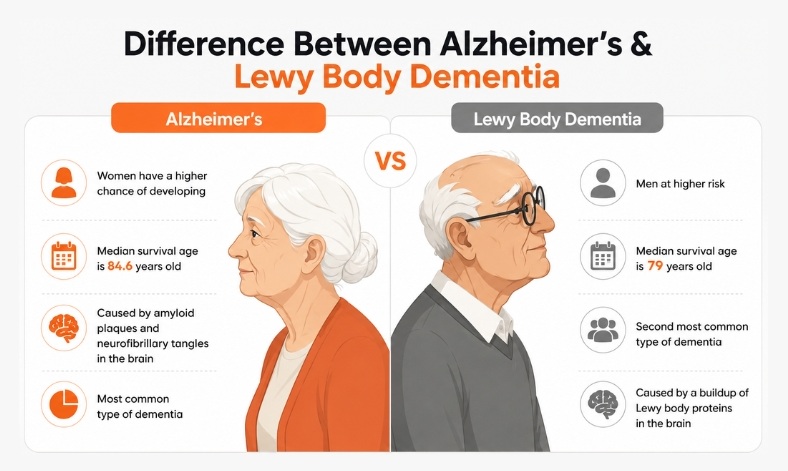
LBD and Alzheimer’s disease are both types of dementia. But they are not the same. They affect the brain in different ways. They also need different treatments. Some medicines that are safe for Alzheimer’s patients can be very harmful for someone with LBD. That is why it is so important to know which disease a person has. The table below shows the key differences between the two.
| Symptom or Feature | LBD | Alzheimer’s Disease |
| Memory loss (early on) | Less common at first | Very common early on |
| Visual hallucinations | Very common | Less common |
| Movement problems | Common in early stages | Usually appears in later stages |
| Day-to-day changes in thinking | Very common | Less common |
| Sleep acting out (REM disorder) | Very common | Rare |
| Risk from antipsychotic drugs | High risk | Lower risk |
Is Lewy body dementia worse than Alzheimer’s?
Lewy body dementia is not always worse than Alzheimer’s, but it can be harder to manage. This is because it brings together memory problems like Alzheimer’s and movement issues like Parkinson’s disease.
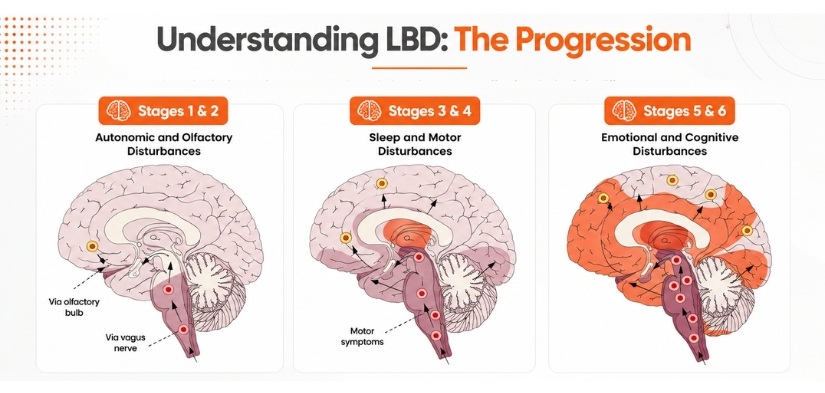
While LBD does not always follow exact stages like some other diseases, doctors often describe its progress in general phases. Every person with an LBD is different. Some people move through stages quickly. Others stay in one stage for a long time. Understanding these stages can help families plan and get the right support at the right time.
Here is a simple look at how LBD tends to move forward:
Stage 1: No Signs Yet
The person feels and acts normally. Lewy bodies may be forming, but no symptoms have yet.
Stage 2: Very Mild Changes
The person may forget small things. Others may not notice anything wrong.
Stage 3: Mild Symptoms
Some thinking problems start. The person may have trouble with planning or organizing. They may act a little differently.
Stage 4: Moderate Symptoms
Clear signs of LBD symptoms appear. The person needs some help with daily tasks. Hallucinations may start.
Stage 5: Moderate to Severe
The person needs a lot of help. Thinking problems are serious. Movement issues are getting worse.
Stage 6: Severe
The person cannot do much without help. They may not know their family members. Sleep and behavior problems are very hard to manage.
Stage 7: Very Severe (End Stage)
The person cannot speak or move well. They need full-time care for all their daily needs.
LBD affects each person differently, so it can be difficult to know what to do next. Our guide offers a clear roadmap to help you through each stage. Read the Improved Dementia Experience Guide Model to get started.
This is one of the most asked questions by families. How fast does Lewy body dementia progress?
The honest answer is that it is different for each person. LBD usually moves faster than Alzheimer’s disease. Most people live for 5 to 8 years after their first symptoms. Some people live for up to 20 years. Others decline much faster.
Things that can affect how fast LBD progresses include:
The disease always gets worse over time. There is no cure right now. But good care can help a person live better for longer.
Can Lewy body dementia be cured?
No, there is no cure for LBD right now. However, specialized care and treatments can help manage symptoms related to thinking, movement, and behavior.
Even though there is no cure, LBD treatment can help a lot. The right treatment can reduce symptoms and improve quality of life.
| Type of Care / Treatment | How It Helps | Examples |
| Medicines for thinking | Help with memory and attention | Cholinesterase inhibitors |
| Medicines for movement | Reduce tremors and stiffness | Carbidopa-levodopa |
| Medicines for mood | Help with depression and anxiety | Antidepressants |
| Physical therapy | Improves strength and balance | Exercises, stretching |
| Occupational therapy | Helps with daily tasks | Adaptive tools, routines |
| Speech therapy | Helps with swallowing and speaking | Vocal exercises |
| Sleep treatment | Reduces acting out of dreams | Melatonin, other sleep aids |
One important warning: some common antipsychotic medicines are very dangerous for people with LBD. Medicines like haloperidol can make movement symptoms much worse. They can even cause a life-threatening condition called neuroleptic malignant syndrome. Always tell every doctor that the person has LBD before starting any new medicine.
Here’s a quick tip: LBD doesn’t always progress in a straight line. Using a structured care guide can help families prepare sudden changes in thinking, enabling them to respond calmly rather than react to emergencies.
LBD can be hard to diagnose because many symptoms look like Alzheimer’s disease, Parkinson’s disease, or other brain conditions. A person may have problems with memory, movement, sleep, mood, or behavior, and these symptoms can change over time.
Doctors diagnose LBD by learning about the person’s symptoms and daily changes. Family members and caregivers often help doctors understand what problems are happening at home. Doctors may also:
There is no cure for LBD right now, but treatment can help manage symptoms and improve daily life. Treatment plans may include:
An LBD diagnosis can put a lot of stress on family relationships and sometimes cause disagreements about medical choices. Our course, Handling Family Interactions in Dementia Care, can help you communicate more effectively and support family members.
LBD changes lives. It affects how a person thinks, moves, sleeps, and feels. It also affects every family member who cares for them.
There is no cure for LBD right now. But the right treatment, the right care team, and the right support can make a real difference. Knowing the Lewy body dementia symptoms early leads to faster, safer care. Understanding how LBD progress helps families plan. And learning about safe Lewy bodies treatment options helps protect the person from harm.
No one must face LBD alone. Support groups, care teams, and organizations like the Lewy Body Dementia Association (LBDA) can help families get through this together.
Platforms like Learn2Care help caregivers build skills in dementia care, safety awareness, communication, and daily care support through structured training programs.
Transform your caregiving with Learn2Care
Caring for someone with Lewy Body Dementia can be challenging, and standard care guides often miss important details. Learn2Care offers specialized, evidence-based dementia training to help lower caregiver stress and improve the quality of care.
Our courses provide both professional caregivers and family members with practical ways to manage behavioral changes safely.
Explore Learn2Care’s expert dementia care training programs today.
What is LBD, and how is it different from Alzheimer’s?
LBD happens when protein clumps called Lewy bodies build up in the brain and damage brain cells. LBD is not the same as Alzheimer’s. With LBD, a person may see things that are not there, have trouble moving, and think clearly one hour but not the next. Some medicines that are safe for Alzheimer’s can be very harmful for someone with LBD.
What are the early LBD symptoms to watch for?
Early signs include seeing things that are not really there, acting out dreams while asleep, and having days when thinking seems good and days when it seems very poor. Slow walking and stiff muscles can also show up early. These signs should never be brushed off or ignored.
How fast does LBD progress?
It is different for each person. On average, people live 5 to 8 years after symptoms begin. Some live longer. LBD often moves faster than Alzheimer’s disease. The right care and treatment can help slow the impact on daily life.
What are the 7 stages of LBD?
LBD generally moves through stages from no symptoms, to mild thinking problems, to moderate needs for help, to full care in the final stage. Not everyone goes through every stage the same way. The disease always gets worse, but the speed is different for each person.
Are there safe treatment options for LBD?
Yes. Dementia Lewy bodies treatment includes medicines for thinking, movement, mood, and sleep. Physical, speech, and occupational therapies also help. The most important rule is to avoid traditional antipsychotic medicines, which can be very dangerous for people with LBD. Always check with a doctor who knows LBD before starting any new medicine.
Related Blog Posts-
Key Strategies for Enhancing Independence in Seniors with Dementia
Dementia Training for Caregivers: Everything You Need to Know
Find your next read and expand your knowledge
Contact us to inquire about our state-wise training courses and take the first step towards upskilling your team with a 14-day free trial!