Quick Summary
Finding and keeping good in-home caregivers has never been harder — the workforce just isn’t keeping pace with demand. That’s where AI comes in. It’s helping home care agencies match caregivers more accurately, catch health problems earlier, train staff faster, and stay ahead of compliance requirements. But it’s not taking over. Every serious report on this topic lands on the same conclusion: AI should support caregivers, not stand in for them. Here’s a look at the top 10 ways AI is reshaping in-home senior care — with real numbers, an agency-first lens, and a few honest warnings mixed in. Families researching in-home senior care services and agencies evaluating new caregiver training technology will both find practical takeaways below.
According to the U.S. Census Bureau, America’s senior population is set to reach 73 million by 2030. That means nearly seven out of ten older adults will need long-term care at some point in their lives (Source: U.S. Department of Health and Human Services, Administration for Community Living). Right now, about 800,000 seniors who already qualify for subsidized home care are waiting—often for months because there simply aren’t enough caregivers to go around (Source: KFF, Kaiser Family Foundation).
The workforce numbers back this up. The Bureau of Labor Statistics projects employment of home health and personal care aides to grow somewhere between 17% and 21% over the next decade — faster than almost any other occupation in the country — with hundreds of thousands of openings needed every single year just to keep pace. At the same time, the number of unpaid family caregivers has climbed to 63 million Americans in 2025, a 45% jump since 2015, according to AARP and the National Alliance for Caregiving. Families are stretched thin. Agencies are stretched thin. And the gap between what’s needed and who’s available keeps widening.
So, it’s no surprise that AI in home care is growing so fast. Agencies searching for an AI-powered caregiver training platform, and families comparing in-home caregivers for seniors, are both running into the same conclusion: technology is now a core part of how in-home senior caregivers are trained, matched, and supported.
If you run a home care agency trying to keep up with demand while controlling labor costs and compliance risk, this matters directly to your bottom line. Let’s get into it.
Before diving into each of the ten shifts in detail, here’s a quick snapshot of what’s changing in the day-to-day of home care.
| Task | Old Way | AI-Assisted Way |
| Matching caregiver to client | Manual resume review | Smart matching by skills, location, personality |
| Fall detection | Phone check-ins | Real-time sensor alerts |
| Training | In-person classes only | On-demand training modules |
| Medication reminders | Sticky notes | Automated alerts and dispensing |
| Compliance | Spreadsheets, manual audits | Automated compliance dashboards |
| Traditional Home Care | AI-Enhanced Home Care |
| Manual scheduling | Automated, traffic- and availability-aware scheduling |
| Paper compliance tracking | Real-time compliance monitoring |
| Reactive care | Predictive alerts |
| Classroom-only training | On-demand, scenario-based learning |
| Limited workforce insights | Turnover prediction and retention support |
Here are the top ways AI is changing the home care sector:
In the past, most agencies matched caregivers and clients by relying on gut feelings or on whoever happened to be available. Sure, that sometimes worked out, but it often led to mismatches—like a caregiver who couldn’t speak the client’s language, or someone whose schedule never quite fit. Now, AI matching tools look at dozens of details all at once: language, location, personality, and more. For agencies, this means fewer last-minute cancellations, less money wasted on finding replacements, and more long-lasting caregiver-client relationships.
AI-powered training tools can walk new hires through real situations now—what do you do if a client falls, how do you spot the early signs of confusion—and then actually check whether it stuck. This kind of AI-driven caregiver training, delivered through a modern home care training platform, means new caregivers ramp up faster, orientation takes less time, and supervisors can spot who’s struggling before it becomes a real problem.
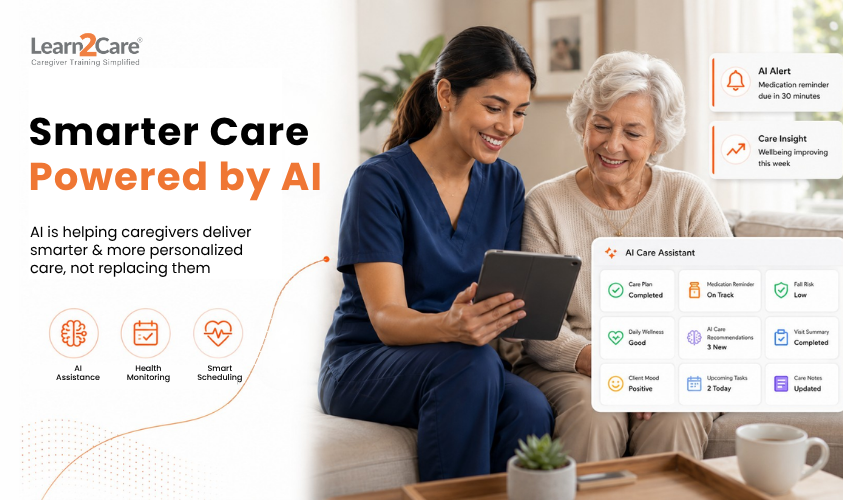
Wearable devices like smartwatches and home sensors now quietly keep an eye on things like heart rate, sleep, and movement—all day, every day. If something unusual pops up, like an irregular heartbeat, the system immediately alerts a nurse, caregiver, or family member. It’s not meant to replace a diagnosis, but it serves as an early warning system. For agencies, this isn’t just about catching issues sooner—it also provides a record that shows families and insurance payers that changes in health were noticed and acted on quickly, not missed.
Falls are one of the biggest dangers seniors living alone face. The CDC reports that more than one in four adults over 65 falls each year, making falls the leading cause of both serious and minor injuries in that age group (Source: Centers for Disease Control and Prevention). AI-powered sensors can now detect a fall or even unusual, sudden movement and send an alert within seconds, well before anyone would notice something’s wrong on their own.
These systems also build a reliable record for families and care teams, cut down on legal exposure, and can even factor in severe weather to flag extra risk for frail clients. Pairing a sensor system with a simple wearable emergency button adds peace of mind, too—if the internet goes down, that backup button still works.
Trying to organize a weekly schedule for lots of caregivers—each with their own availability—used to take office staff hours every week. Now, AI tools can handle most of this automatically, taking into account everyone’s schedules, where they live, and even local traffic. That means staff can spend less time on paperwork and more time actually talking with caregivers and families. The payoff? Fewer missed or late visits, happier clients, and less stress about meeting compliance requirements.
Caregivers can’t be there 24/7, and for many seniors, loneliness isn’t just tough emotionally—it’s a real health risk. About one in four older adults lives with social isolation (Source: Centers for Disease Control and Prevention / National Health and Aging Trends Study), which is linked to problems like depression, heart disease, and even dementia. AI-powered companion devices can chat, remind someone to call their grandkids, or notice when a senior seems down compared to usual. While these devices can’t replace real human company, they do help bridge the gap between visits and give families peace of mind that their loved one isn’t alone all the time.
Just remember: AI companions work best when they’re part of a regular schedule of human visits, not a substitute for them.
Caregivers once spent a lot of time after every visit writing up notes—time that could have been spent with clients. Now, AI note-taking tools can listen in during a visit and automatically create a summary. It might sound like a small change, but for agencies with many caregivers, it adds up to hours every week that can go back into caring for clients. Plus, the documentation is more consistent, which is helpful for audits and care reviews.
Home health agencies have to follow a lot of rules—federal ones like the Centers for Medicare & Medicaid Services’ requirements, plus state rules that change all the time. Records need to be kept for years and be ready for audits at any moment. Trying to track all of this manually is nearly impossible. AI-powered compliance tools now keep up with changing rules across every state, flag missing certifications, and warn managers about issues before they turn into violations. This is where AI in home care compliance and a dedicated caregiver compliance platform make the biggest difference for agencies managing multi-state operations. These tools have quickly become essential for agencies that want to avoid costly mistakes as they grow.
Tip: A compliance platform is only as reliable as its data. Before choosing one, ask how often it updates its rules and requirements.
Turnover is a huge challenge in home care, with some estimates saying as many as 65% of caregivers leave their jobs each year. That means agencies are constantly recruiting, screening, and retraining—and scrambling to cover open shifts. Agencies that understand why caregivers quit in the first 90 days and take proactive steps to improve retention can significantly reduce rehiring costs and maintain a stable workforce. AI tools can now find patterns in attendance and job performance that might mean someone is thinking about quitting, giving managers a chance to check in, offer support, or fix issues before it’s too late. When combined with solid hiring and training programs, these early warnings can save agencies a lot of money and keep more good caregivers on the team.
Every senior is different, and their care should feel that way too. AI helps build care plans that actually keep up—as someone’s health or preferences shift, the plan shifts with them. That could mean tracking mobility needs, medication schedules, favorite meals, or even how they take their coffee in the morning.
This isn’t about replacing caregivers. It’s about giving them what they need to focus on the person, not the paperwork. And for agencies, it means being able to show families and insurance payers that care is genuinely personalized—not something that got set once and forgotten.
| Category | AI Tool Example | Main Benefit |
| Training | AI-driven caregiver training | Faster onboarding |
| Compliance | Compliance dashboards | Fewer missed regulations |
| Health | Smart wearables | Early warning signs |
| Staffing | Turnover prediction | Better retention |
| Companionship | AI chatbots | Less isolation |
Industry research projects the U.S. home care sector will generate over 6.1 million job openings between 2024 and 2034 (Source: PHI, PHI National) — the second-highest of any occupation in the country. Harvard Public Health researchers put it even more bluntly, projecting 4.6 million unfilled home care jobs by 2032 if nothing changes. A handful of forces are pushing agencies toward AI for home care agencies specifically to close that gap:
That’s the backdrop: AI for home care agencies is stepping in. It’s less about innovation for its own sake and more about survival — and, increasingly, about staying competitive with agencies that have already made the switch.
If you’re searching for in-home senior caregivers for a parent or spouse, it’s worth asking agencies directly what tools they’re using. A good one will give you a clear, specific answer — not a vague “we use technology.”
Most home care agencies already know that AI is full of potential. The real challenge is finding solutions that truly make caregivers’ lives easier and help with real workforce and compliance headaches—not just another dashboard that gathers dust. That’s where Learn2Care comes in. Learn2Care’s 360 Care AI Suite brings together caregiver training, compliance management, workforce support, and caregiver engagement—all designed specifically for the needs of home care agencies looking for a true AI-powered caregiver training platform and caregiver compliance platform in one place.
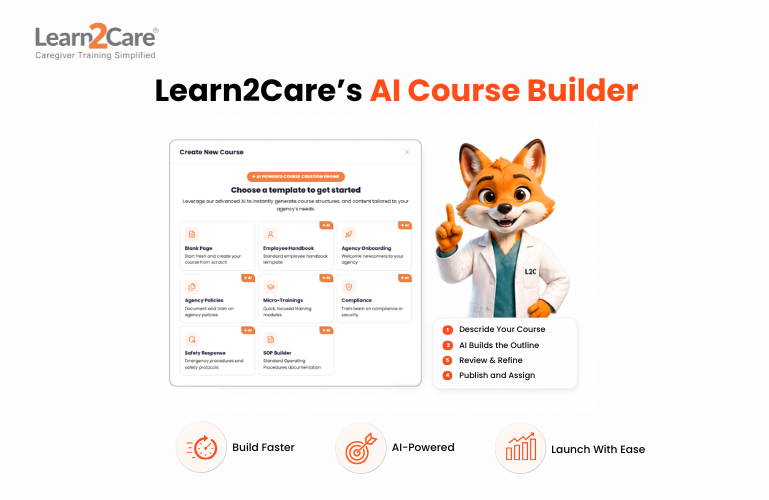
Keeping training materials up to date is a real struggle, especially when regulations and best practices are always changing. With Learn2Care’s AI Course Builder — a purpose-built home care training platform — agencies can quickly build and refresh caregiver training, compliance courses, onboarding guides, and state-specific materials—without reinventing the wheel every time there’s a change.
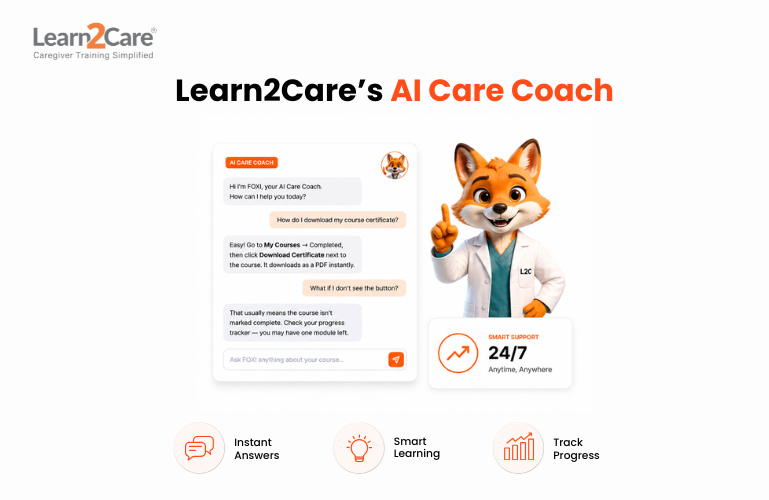
Caregivers often find themselves in tricky situations where they need guidance fast, but a supervisor isn’t always available. That’s when Learn2Care’s AI Care Coach steps in. It offers on-demand answers—helping caregivers with care procedures, training concepts, documentation, and best practices, all based on the approved training and policies.
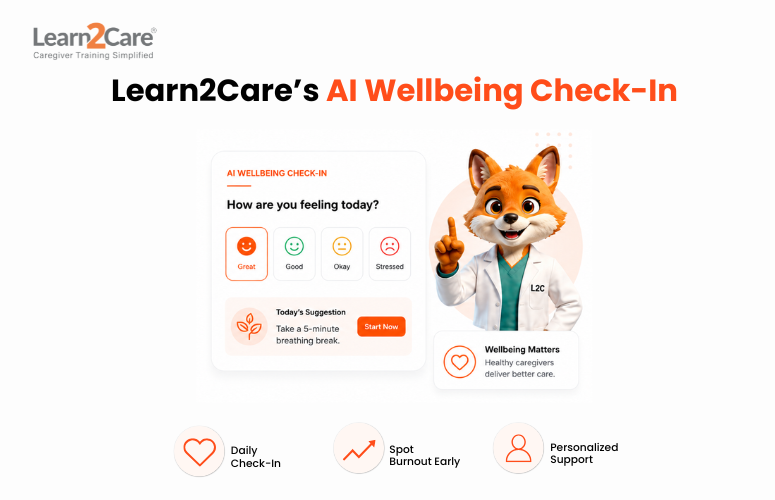
Burnout and feeling disconnected are some of the main reasons caregivers leave this field. Learn2Care’s AI Well-Being Insights help agencies notice early signs of stress or fatigue—so managers can offer support before someone decides to quit.
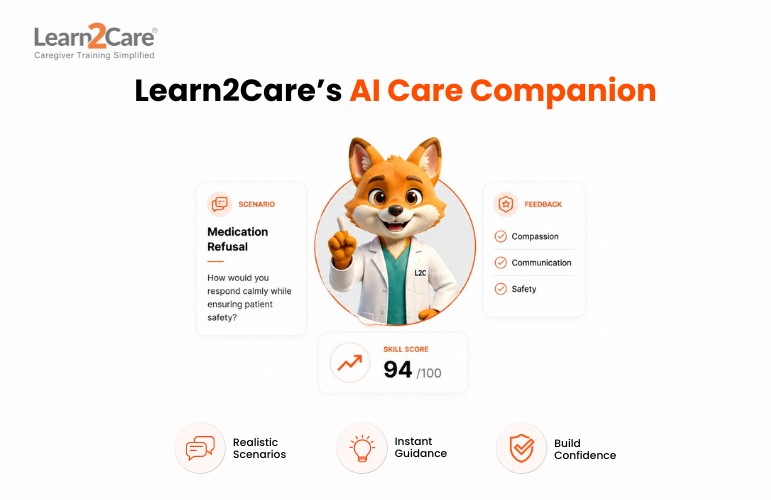
Learn2Care’s AI Care Companion gives caregivers the chance to practice real-life care scenarios in a safe, virtual environment before working with actual clients. This helps build confidence and prepares caregivers for the challenges they’ll face on the job.
See What Learn2Care 360 Care AI Can Do for Your Agency!
Empower your team with AI-driven caregiver training, instant care guidance, automated course creation, and actionable workforce insights.
AI is here to make life a bit easier for the caregivers already doing this tough, important work. Whether it’s helping with training, spotting falls, or organizing schedules, AI can help agencies do more with the staff they have without cutting corners on care. But change only happens when AI is used to support caregivers, not replace them. The agencies that really get it right aren’t just jumping on the latest tech trend. They’re focused on real needs, like helping new team members learn quickly through better caregiver training technology, or showing families that their loved ones — and the in-home senior caregivers looking after them — are truly cared for.
Ready to See AI in Action? See how Learn2Care helps home care agencies simplify training, stay compliant, support caregivers, and cut down on turnover—all through one AI-powered platform.
AI supports scheduling, caregiver-client matching, training, health monitoring, fall detection, documentation, and compliance tracking. The goal is to support caregivers’ judgment, not replace it.
Faster onboarding, fewer scheduling conflicts, lower turnover, stronger compliance, and less administrative time buried in paperwork — which frees staff up to focus on actual client care.
Compliance platforms track shifting state and federal requirements — including CMS Conditions of Participation — flag missing certifications, and alert managers before a violation happens, rather than after a survey finding. This is the core of what AI in home care compliance is designed to solve.
Yes, generally within seconds of unusual movement — though pairing it with a wearable emergency button is smart backup in case something goes wrong with the connection.
Quickly — the global AI in elder care market is projected to grow at a 24.3% annual rate in 2026 alone (Source: The Business Research Company), while the Bureau of Labor Statistics projects double-digit growth in home health and personal care aide jobs through the mid-2030s. Whether you’re an agency exploring in-home caregivers for seniors or a family researching the best in-home care for seniors, AI in home care is quickly becoming the standard, not the exception.
Related Blog Posts-
AI in Home Care Training: Empowering Agencies & Caregivers
How Generative AI is Reshaping Homecare & Caregiver Training
Find your next read and expand your knowledge
Contact us to inquire about our state-wise training courses and take the first step towards upskilling your team with a 14-day free trial!