Summary
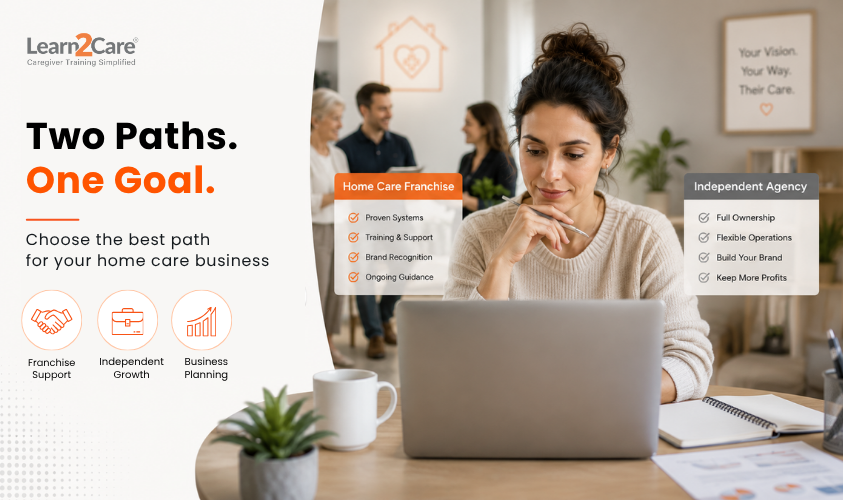
Starting a home care business is one of the biggest decisions you will ever make. Two paths are in front of you: buy into a home care franchise or build your own independent agency from scratch. Both can work. Both have real trade-offs. This guide walks you through 10 key differences so you can make a smart, confident choice. Whether you are brand new to the industry or already working in home care, this guide gives you what you need to move forward.
Introduction
The home care industry is growing fast. According to NCBI, about 8,000 Americans turn 65 every day. By 2030, there will be around 72.1 million seniors in the United States. By 2040, that number is expected to reach 80 million. This means the demand for quality home care is not slowing down anytime soon.
For entrepreneurs and home care professionals, this growth represents a serious business opportunity. But one of the first questions you have to answer is this: do you buy a franchise for home care or start an independent agency?
There is no single right answer. The best choice depends on your budget, your experience, your goals, and how much control you want over your business. This blog breaks down 10 key areas where franchises and independent agencies differ so you can decide which path fits you best.
What is a home care franchise? Quick Answer
A home care franchise is a licensed business arrangement where you pay a fee to use an established brand’s name, systems, and support to run your own home care agency. You follow the franchisor’s guidelines in exchange for access to their proven business model and resources.
Comparing Your Options: Franchise or Independent Agency?
Choosing between a franchise and an independent agency is not easy.
To make it simpler, here is a side-by-side look at how the two models stack up across the factors that matter most:
| Factor | Home Care Franchise | Independent Agency |
| Startup costs | Lower upfront, ongoing royalties | Higher upfront, no royalties |
| Business support | Extensive from day one | You build it yourself |
| Brand recognition | Established brand | Build from scratch |
| Control | Limited by franchisor rules | Full control |
| Training system | Provided | Must develop your own |
| Risk level | Lower (proven model) | Higher (unproven path) |
| Economies of scale | Yes, through franchisor | No, on your own |
| Professional experience needed | Not required | Helpful but not required |
The U.S. Small Business Administration recommends evaluating not only initial investment costs but also ongoing operational expenses, cash flow requirements, and long-term profitability before purchasing a franchise or starting an independent business.
1. Costs: What Will You Actually Pay?
Money is usually the first thing people think about when starting a home care agency. And it should be. The cost structure is very different between a franchise and an independent agency.
Home Care Franchise Buying Cost
When you buy a franchise for home care, you pay a franchise fee upfront. This gives you access to the brand, the business system, training, marketing materials, and ongoing support. The upfront cost is often lower than what you would spend building all of those things yourself.
Buying a home care agency franchise in the US requires an average total initial investment ranging from $90,000 to $250,000. Within this figure, the up-front franchise fee typically costs between $30,000 and $60,000. (entrepreneur.com)
That said, franchises do come with ongoing costs. Most franchisees pay a royalty fee every month, usually a small cut of their revenue, in exchange for continued access to the brand and support system. And here is something many new owners do not think about: the franchisor can sometimes require you to make specific investments, like updating your office or rebranding, on their schedule. Not yours.
Independent Agency Costs
Starting an independent agency means you pay for everything yourself. That includes building a brand, developing a website, running marketing campaigns, attending industry conferences, and setting up your operations from the ground up. These costs add up quickly.
The upside? Everything you build is yours. No royalty checks are going out the door every month. Every dollar your agency brings in stays right where it belongs, in your business.
Here is a breakdown of how costs compare:
| Cost Item | Franchise | Independent |
| Startup / franchise fee | Included in package | Brand building costs |
| Website and marketing | Provided by franchisor | Full cost on owner |
| Training system | Built-in | Must build from scratch |
| Ongoing royalty fees | Yes (% of revenue) | None |
| Supplier pricing | Bulk / discounted rates | Standard market rates |
| Operational support | Included | Must hire or outsource |
Note: Specific costs vary widely by brand, region, and business size. Always request a full Franchise Disclosure Document (FDD) before committing.
2. Operational Resources: How Much Support Do You Get?
Running a home care agency involves a lot of moving parts. Staffing, scheduling, compliance, billing, marketing, and client management all have to work together. Where you get help with these tasks depends entirely on which model you choose.
Franchise Support
One of the biggest advantages of buying a franchise for home care is the support system that comes with it. You do not need deep business experience to get started. Franchisors provide a proven business system, a supplier network, access to software tools, and ongoing corporate support. Many franchises also connect new owners with experienced franchisees who can share advice and lessons learned.
This built-in infrastructure makes it much easier for first-time business owners to hit the ground running. You are not starting from zero. You are plugging into a system that already works.
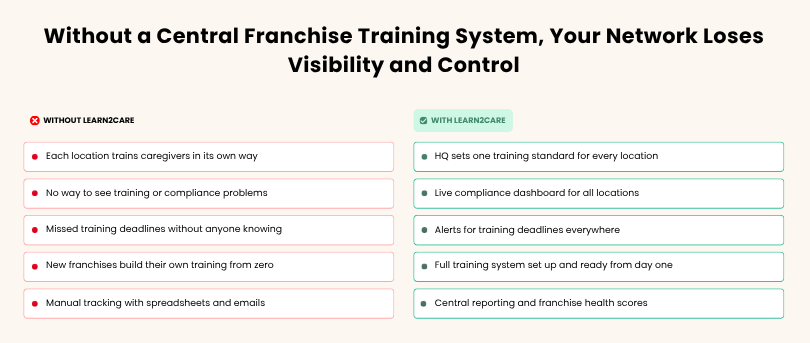
If you are opening a new franchise or running an existing network, choosing the right caregiver training platform matters as much as your other systems. Learn2Care lets franchise owners keep training consistent, track compliance, and see what’s happening at every location from one dashboard.
Independent Agency Resources
When you open an independent agency, you are on your own from day one. You have to figure out your operations, your hiring process, your compliance systems, and your marketing strategy all by yourself. That is not impossible, but it takes time, money, and often some costly trial and error.
The upside is that you are not locked into anyone else’s system. You can build your operations the way you want and change things whenever you need to.
3. Control: Who Makes the Decisions?
How much control do you want over your business? This is one of the most important questions to ask yourself before choosing a path.
Franchise Control
When you join a franchise, you agree to follow the franchisor’s rules. That means the franchisor may control things like your business location, operating hours, pricing, services offered, signage, marketing messages, and more. You are your own boss in many ways, but you are also operating within a defined set of boundaries.
For some owners, this structure is a feature, not a bug. Having a clear playbook reduces decision fatigue and lowers the chance of making costly mistakes.
Independent Control
As an independent agency owner, you answer to no one but your clients and regulators. You decide the business model, the services you offer, your prices, your brand, your marketing strategy, and your hiring process. You can change direction quickly when the market shifts.
That freedom is powerful, but it also means every decision falls on your shoulders. If something goes wrong, there is no franchisor to call.
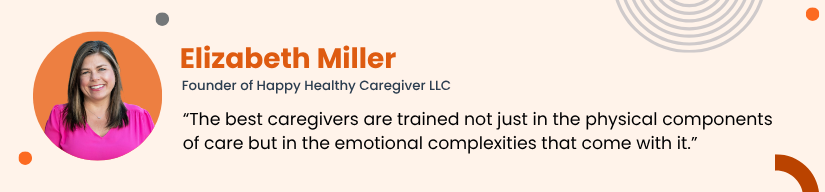
4. Onboarding and Training: How Do You Get Your Team Ready?
Caregiver training is not optional. It is required by law for agencies that receive Medicare or Medicaid funding. It also directly affects the quality of care your clients receive. How you build and deliver that training looks very different depending on your business model.
Franchise Training
Most home care agency franchise opportunities include a formal onboarding program for new owners. This typically includes in-person training, access to training materials, visits to other franchise locations, and ongoing access to a business coach or mentor. You get a training framework that is already built and tested.
Your caregivers benefit too. Franchise systems usually come with standardized training programs that are already built around state and federal rules. So instead of figuring out compliance on your own, you are working with a system that was designed with regulations in mind from the start.
Independent Agency Training
If you are starting an independent agency, you are responsible for building your own training program. That means researching state and federal requirements, developing curriculum, finding instructors or platforms, and tracking completion for every caregiver on your team.
This is one of the most challenging parts of starting a home care agency on your own. Getting training wrong can lead to compliance violations, poor patient outcomes, and serious liability for your business.
5. Brand Recognition: How Will Clients Find You?
In any service business, trust matters. Families choosing a home care provider for a loved one want to work with someone they can trust. Brand recognition plays a big role in building that trust quickly.
Franchise Brand
When you buy a franchise for home care, you get instant brand recognition. Clients in your area may already know the name. That familiarity makes it easier to attract new clients and close new business without spending years building a reputation from scratch.
The downside is that you share the brand with every other franchisee. If another location has a bad experience or the parent company receives negative press, your local business can be affected even if you did everything right.
Independent Brand
Building your own brand takes time and money. You have to earn trust one client at a time. But the brand you build belongs entirely to you. You control the message, the look, and the reputation. If you build something great, all of the credit goes to your agency.
Many of the most respected home care providers in local markets are independent agencies that built strong community reputations over time.
6. Economies of Scale: Can You Lower Your Operating Costs?
Running a home care agency means managing supply costs, software subscriptions, insurance, and more. How much you pay for these things depends in part on your buying power.
Franchise Buying Power
Franchise networks have real buying power. When a franchisor is placing orders for hundreds of locations at once, suppliers and vendors take notice. That kind of scale gets you deals that a single agency simply cannot negotiate on its own. Better rates on supplies, software, insurance, and more. And those savings flow straight to your bottom line.
Independent Buying Power
When you are running an independent agency, you are negotiating on your own. You do not have the same leverage as a large franchise network. That means you will typically pay standard market rates for supplies and services, which can squeeze your margins, especially in the early years of the business.
Some independent agencies join industry associations or buying cooperatives to access better pricing, but it takes time to build those relationships.
7. Risk: How Much Are You Comfortable With?
Every business carries risk. But the level of risk is very different between a franchise and an independent agency.
Franchise Risk
Buying a franchise for home care is generally considered lower risk than starting an independent agency. You are following a proven business model. The franchisor has already worked out many of the kinks, and you benefit from their experience. According to the Franchise Business Review, franchises have historically shown stronger survival rates than independent startups in the service sector.
That said, franchises are not risk-free. You are still running a business. You still have to find clients, manage staff, and stay compliant with regulations. The franchise model reduces risk but does not eliminate it.
Independent Risk
Starting any business is risky. Starting one in a regulated industry like home care, without a proven system to follow, adds to that risk. If you lack experience in the industry or in running a business, the learning curve can be steep and expensive.
That said, many successful independent agencies were started by people with no prior business experience. The key is doing your homework, building the right team, and taking compliance seriously from day one.
8. Professional Experience: Do You Need a Medical Background?
One of the most common questions from people exploring home care agency franchise opportunities or starting a home care agency is whether they need a medical or clinical background. The short answer is no.
Franchise Owners
Franchisors design their systems to work for owners from all kinds of backgrounds. Franchise owners have come from careers in accounting, finance, education, the military, and many other fields. The franchise system provides the clinical and operational framework so that you do not have to be a nurse or doctor to run the business successfully.
Independent Agency Owners
The same is true for independent agencies. You do not need a medical background to run an independent home care agency. What matters more is your ability to hire and manage skilled caregivers, stay on top of regulations, and build strong relationships in your community. Your entrepreneurial drive matters more than your clinical credentials.
9. Technology & Scalability: Will Your Business Grow With You?
As your agency grows, it becomes harder to manage caregivers, compliance, scheduling, documentation, and training manually. Picking the right technology from the start can help you save time and reduce costs.
Home Care Franchise
- Franchises usually give you access to their own software for scheduling, billing, and managing caregivers.
- All franchise locations use the same technology.
- You have less flexibility to add other software or tools.
Independent Agency
- You can pick the software that works best for your agency.
- It’s easier to try out new technology, including AI tools.
- You’ll need to spend more time researching and setting up these tools.
How Learn2Care Helps
Whether you run a franchise or an independent agency, Learn2Care fits right into your training system. It helps you maintain consistent caregiver education, automate compliance tracking, and expand your training as your team grows.
10. Compliance: Who Keeps You Audit-Ready?
Home care agencies operate in one of the most heavily regulated sectors of healthcare. From caregiver training and documentation to state licensing and ongoing education, maintaining compliance is essential regardless of the business model.
Home Care Franchise
- Most franchisors offer standardized policies and documents to support compliance.
- But as an owner, you’re still responsible for meeting your state’s licensing and regulatory rules.
Independent Agency
- Responsible for researching and implementing all federal and state regulations independently.
- You get more flexibility, but you’re also more accountable when it’s time for audits.
How Learn2Care Helps
Learn2Care helps you stay ready for audits by tracking training, maintaining digital compliance records, monitoring certification renewals, and providing reports that make regulatory reviews easier.
Is a Home care franchise right for You?
This question does not have a one-size-fits-all answer. It depends on who you are and what you want out of your business.
A franchise for home care is probably the right choice if:
A Franchise May Be Right for You If…
- You want lower startup risk and a structured path to profitability
- You do not have a background in home care operations
- You are a first-time business owner who wants a proven system
- You want built-in brand recognition from day one
- You prefer having a support team and business coach available
- You are comfortable following established rules and process
An independent agency is probably the right choice if:
An Independent Agency May Be Right for You If…
- You want complete control over every business decision
- You have experience in home care or a related field
- You are comfortable building systems and processes from scratch
- You do not want to pay ongoing royalty fees
- You want to build a brand that is entirely your own
- You are a risk-tolerant entrepreneur who thrives on flexibility
Tip: Before launching your agency, review your state’s licensing requirements along with federal guidance published by the Centers for Medicare & Medicaid Services and business planning resources from the U.S. Small Business Administration.
Key Steps for Starting a Home Care Agency
Whether you choose a franchise or go independent, starting a home care agency requires careful planning. Here are the steps every new owner needs to take:
| Step | Action Item |
| Step 1 | Research your state licensing requirements for home care agencies |
| Step 2 | Decide between a franchise model and an independent structure |
| Step 3 | Secure your funding and understand your full cost structure |
| Step 4 | Register your business and obtain all required licenses and insurance |
| Step 5 | Build or adopt a caregiver training program that meets federal and state standards |
| Step 6 | Hire your first caregivers and conduct background checks |
| Step 7 | Set up your scheduling, billing, and documentation systems |
| Step 8 | Launch your marketing and start building your client base |
Common Mistakes When Choosing Between a Home Care Franchise and an Independent Agency
Picking a business model is just the beginning. Many new agency owners face problems because they focus only on this first choice and overlook what it takes to run a home care business over time. Here are some common mistakes to watch out for:
1. Focusing Only on Startup Costs
Franchises might be easier to set up at first, but ongoing royalty fees and other regular costs can reduce your profits over time. Independent agencies usually need more money upfront for branding and operations, but you won’t have to pay franchise royalties again and again.
2. Underestimating Caregiver Recruitment
Your business depends on the quality of your caregivers. Finding, hiring, and keeping good caregivers is one of the biggest challenges for both franchises and independent agencies.
3. Ignoring State Licensing and Compliance Requirements
Each state has different rules for licensing and caregiver training. If you assume the rules are the same everywhere or only follow general advice, you could face delays or run into compliance problems.
4. Overlooking Ongoing Operational Expenses
Startup costs are just one piece of the puzzle. You’ll also need to plan for expenses such as- insurance, payroll, technology, marketing, caregiver training, software, and meeting regulatory requirements.
5. Not Budgeting for Marketing and Client Acquisition
Independent agencies usually must spend more on local marketing and building community partnerships. Franchise owners should also set aside money for local outreach, even if they benefit from a national brand.
Why Choose Learn2Care?
Agencies across the United States choose Learn2Care to help their teams stay trained, compliant, and confident. Here is why:
| Feature | Description | Key Capabilities |
| Reporting & Analytics | Strong reporting tools provide network-wide visibility into training progress, course completion, and user activity across all locations. |
|
| Billing & Usage Visibility | Clear billing tools help leaders track seat usage, training activity, and invoice history across every location. |
|
| Combined Franchise Dashboard | A centralized dashboard provides real-time visibility into activity across all locations and helps identify compliance issues early. |
|
| Overall Health Score | A scoring system categorizes locations as Healthy, Needs Attention, or High Risk based on training and performance metrics. |
|
| Compliance Training Tracking | A centralized system tracks active, upcoming, and expired training requirements across all locations to maintain audit readiness. |
|
Wrap-Up
The home care industry is one of the fastest-growing sectors in the United States. Whether you choose a franchise for home care or an independent agency, you are entering a business that makes a real difference in people’s lives.
Both paths can lead somewhere great. What separates the ones that make it from the ones that do not is going in prepared. Know the trade-offs. Be honest about your budget, your experience, and how you like to work.
At Learn2Care, we support agencies of every kind. Independent or franchise, new or established, we are here to help you build a training program that keeps your caregivers confident, your clients safe, and your agency compliant.
Ready to strengthen caregiver training, improve compliance, and support long-term growth? Learn how Learn2Care helps both independent agencies and franchise owners build confident, well-trained caregiving teams.
Explore solutions for agency owners: Agency Owners Resource Center
Explore solutions for franchise owners: Franchise Owners Resource Center
Ready to build a stronger care team? Let Learn2Care show you how. Get Started with Learn2Care
Key Takeaways
- The U.S. home care market is growing rapidly, driven by an aging population of 72 million seniors expected by 2030 (U.S. Census Bureau).
- A franchise for home care offers lower startup risk, built-in support, and brand recognition in exchange for ongoing royalty fees and reduced control.
- An independent agency gives you full control and no royalty fees but requires you to build your brand, operations, and training systems from scratch.
- Franchise cost varies by brand but typically includes a franchise fee plus ongoing royalties; independent costs are higher upfront but stop there.
- Neither model requires a medical background. What matters most is strong management, compliance focus, and a commitment to caregiver quality.
- Once you hire caregivers, training becomes one of your biggest responsibilities. For Medicare and Medicaid agencies, it is critical to patient safety and business reputation regardless of which model you choose.
- Starting a home care agency in either model requires state licensing, proper insurance, a compliant training program, and solid operational systems.
- Learn2Care supports both franchise and independent agencies with online caregiver training that meets all state and federal requirements.
FAQs for Aspiring Caregivers
Can I run a franchise for home care without a medical background?
Yes. Most opportunities are designed for business owners from all kinds of backgrounds. The franchisor provides the operational and clinical framework. Your job is to manage the business, hire quality caregivers, and serve your clients well.
What is the difference between a senior home care franchise and a regular franchise for home care?
A senior home care franchise specifically focuses on serving older adults, typically those who are 65 and older. Services may include personal care, companionship, medication reminders, and support for daily activities. A general franchise may serve a broader population including adults with disabilities or those recovering from surgery or illness.
What is the biggest challenge of starting a home care agency independently?
The biggest challenge of starting an independent agency is building everything from scratch. That includes your brand, your marketing, your operations, your compliance systems, and your caregiver training program. Without a franchisor’s support, every decision and every mistake lands entirely on you.
Does Learn2Care work with both franchises and independent agencies?
Yes. Learn2Care is built for home agencies of every size and structure. Whether you are part of a franchise network or running an independent agency, our online training platform helps you meet state and federal caregiver training requirements with ease.
Related Blog Posts-
How to Start a Non-Medical Home Care Business
The Home Care Leader’s Guide to Building a Strong Agency Culture
Medical Disclaimer
This article is for general educational purposes only and does not replace advice from your own dentist. Recovery timelines and aftercare instructions vary from patient to patient. Always follow the specific post-operative instructions you were given after your procedure, and contact our office if you have questions or concerns.
The 8th Avenue Dental Team
Our dentists and hygienists in Fort Worth write and review every article on this blog, so the guidance you read here matches what we actually do in the practice — from implant aftercare to cleanings and whitening.